

You're Invited
... to a conversation with Adnan Hadad. Plus: Watch the Kurds.

Hi Everyone,
We had an excellent turnout for our discussion of Venezuela last week—and an excellent discussion. So perhaps you might like an invitation to tomorrow’s conversation, too.
We’ll be returning to the Middle East, where we’ve just begun our exploration of the Arab Spring. We have an especially interesting guest tomorrow: Adnan Hadad will be joining us to discuss the Syrian revolution, the civil war, the fall of Assad, and the future of Syria and the Middle East. He’s unusually qualified to discuss the Syrian revolution: He was a Syrian revolutionary.
When it began, he was working as a wealth manager for HSBC in Dubai. Here is how he describes his decision to join the revolution:
… I believed that if people had a chance to speak and be heard, peacefully, common sense would prevail. I’m not saying I was wrong, but I sure didn’t realize back then it would mean we’d have to fight a war against Assad, ISIS, Iran, Russia and God-knows-how many militias who poured into the country from all over the world, all at the same time.
I started with a project to get funding to purchase satellite phones and other telecommunications equipment that I arranged, surreptitiously, to be transported to Syria with truck drivers. I quickly realized, though, that this was a pitifully inadequate solution.
That’s when I had the idea of starting a media organization in Aleppo. So in September 2012, I co-founded the Aleppo Media Center, with six other people. The center was the most significant group delivering high-quality reporting about events in Aleppo—until Russia destroyed the city in 2016. The center also filmed The White Helmets, which won the Academy Award for best documentary in 2017. I also co-founded Radio Hara, a local radio station in Aleppo, and Lamba Media Productions, a local production house.
You’ve read his work here before. He’s the author this unbearably prophetic essay:
… My advice to the Ukrainians is this: Cooperate with the West and take those weapons and aid because you need it, but never fall under the delusion that the West is doing this to defeat the Russians. You may have everybody’s eyes and ears in Western capitals right now, but soon people will get used to horrible news from Ukraine. It just becomes normal news. Don’t lay down your weapons if you want to fight for your dignity and country, but never count on any external help to liberate your land. That help will run dry when their interests are no longer aligned with supporting your resistance. You have to prepare for the worst-case scenario—being left alone to face your own destiny. Seeing your cities turned into rubble and your people enslaved by your enemy. Becoming refugees in a foreign land, living among people you thought would care about you forever, but didn’t. Be prepared to be blamed for your own death and destruction if at some point you refuse to surrender. Your lives might be worth more than Syrian lives, but they’re definitely not worth more than Western lives, let alone the risk of a nuclear confrontation with Putin and his generals. Resist because there’s dignity in the act of resistance, even if you know you’ll lose. Resist because you don’t want history to remember that you gave up on your country and your future without a fight. But don’t resist because you think someday the world will hear you. This world is deaf!
… When I saw those images from Mariupol and Kharkhiv, it was déja vu. Different year, different city, same murderer. The same people, the same love for their country, the same motivation to defend everything they love from being taken away from them forever. The same desperation that they might not have a chance to live another day. The same tactics. The same ghastly weapons. Even the same statements issued from Western capitals by politicians who are talking like reporters, or news columnists, instead of statesmen in charge of preventing a fragile world order from collapsing.
… The scars and trauma that Ukrainians will feel as they see their cities fall, one after another, that will be with them for years. They’ll view the whole world through that trauma. It will feel as if the only way they can move on is to see the Russian army and Putin pay the price for what they did, at last. Until that day comes, those scars will be the one thing they can hold on to—the only shred of their identity left, the only way to remember who they are.
… That was one of the hardest things about going through what happened in Syria. The world’s denial that it had happened at all. You put your life at risk to report the story, to show that you’ve been the victim of heinous war crimes, outrageous human rights violations—then some dude living in his grandmother’s garage starts questioing you on Twitter with recycled Russian propaganda talking points. You can’t help but feel angry and frustrated. I even got to the point where I stopped working with foreign journalists because there was no point to it. You’re either broaching the same subject with people who already believe what you’re saying but can’t do much to help, or you’re talking to people who think you’re some kind of lab-created Western propaganda tool.
For Russia, Syria was a laboratory for dirty tricks—not just a place to field test weapons, but a way to test the effectiveness of their propaganda strategies. Putin and his regime mastered exploiting the free speech environment of Western social media to inject doubt about anything and everything. They figured out that you don’t actually have to have a consistent narrative to counter the truth; all you need to do is create confusion about the facts, so people who aren’t news savvy don’t know what to think.
(For my Ukrainian readers: Tomorrow’s conversation might be especially interesting for you, and as always, you’re warmly invited.)
I wrote this article to introduce Adnan to our readers:
To prepare, the group has been reading Assad or We Burn the Country, by Sam Dagher, but you don’t need to read it to join the discussion. I do recommend reading the articles by Adnan, however, and watching The White Helmets, filmed by the Aleppo Media Center:
Adnan sent a few more suggestions for those who’d like to prepare. (For ME201 students, these are required reading and viewing. For everyone else, they’re highly recommended reading and viewing.)
… Over the past couple of days, I revisited many of my own contributions to reporting on Syria while preparing for our discussion. That journey inevitably brought me back to the Aleppo—because Aleppo, in many ways, was the war.
Why Aleppo? For several reasons. It is Syria’s largest city by population and its economic capital. Control over Aleppo translated directly into political legitimacy. This dynamic played out repeatedly: When rebels partially captured the city, when the regime retook it in 2016 through relentless carpet bombing, and again in November 2024, when HTS seized control—an event that triggered the rapid and dramatic collapse of the regime within days.
Aleppo witnessed almost every form of atrocity imaginable: systematic bombing of civilians, mass infrastructure destruction, chemical weapons deployment, ISIS terror campaigns, massacres, sieges, and starvation tactics. For this reason, I’ve always seen Aleppo as the true epicenter of the Syrian conflict.
I spoke with BBC Newshour about the situation in Aleppo several months before the final assault on the rebel-held areas. My last visit to the city had been in April 2016, just as Russia began its first large-scale aerial bombing campaign against the eastern, opposition-controlled neighborhoods—home to nearly one million civilians at the time. Standing there, it was already clear to me that Aleppo could not withstand what was coming.
The city was subsequently placed under siege, and its residents were forced to survive under devastating conditions until it ultimately fell in December 2016. From that moment, it appeared to the world that the Assad regime and its allies had secured a decisive victory. The BBC segment described Aleppo as “Syria’s Stalingrad”—a phrase that powerfully captured both the city’s symbolic importance and its strategic weight:
But there is another side of the story—one that rarely makes it into international headlines.
Alongside the destruction, there was also life, service, creativity, and stubborn hope. Grassroots initiatives emerged everywhere: community radios, underground schools, local councils, emergency responders, and citizen journalists. People organized food distribution, documented war crimes, ran clinics, and kept cultural spaces alive—often under daily bombardment.
This is the side of Syria that activists like Rami, myself, and many others felt compelled to document. We wanted to show not only how Syrians were dying, but also how they were living—resisting despair, preserving dignity, and building alternatives in the most impossible conditions. We kept telling those stories until the very last day Aleppo fell to Assad.
Two pieces that capture this spirit particularly well:
- A short video on our grassroots media work.
A New York Times article on Radio Hara, our pirate radio station in Aleppo.
It’s been a while since I last spoke to Adnan. In fact, it will be the first time we’ve spoken since Assad’s regime collapsed. We have so much to talk about.
As usual, we meet at 4:30 pm Paris time tomorrow. Don’t be shy. If you’re interested, come. I’ll send you a reminder tomorrow. The Zoom link is below the paywall. (Yes, that’s deliberate. It’s well worth subscribing to participate in this discussion. Adnan will be a truly interesting guest.)
Watch the Kurds
Here are a few recent Middle East news items, from Syria in particular, for the regular ME201 group—or for anyone who’s interested, but I especially want to the ME201 group to take note. My emphasis in bold.
The president and his national security advisers contemplated striking Iran but backed away as costs loomed and Middle East allies lobbied for restraint:
… Having deployed an aircraft carrier strike group and an accompanying armada to the Caribbean on Trump’s orders, Pentagon officials worried that there was less US firepower in the Middle East than would be ideal to repulse what was expected to be a major Iranian counterstrike. Israel shared that concern, having expended vast numbers of interceptor rockets against incoming Iranian missiles during their 12-day war in June, one current and one former US official said.
Key US allies, including Saudi Arabia, Qatar and Egypt, contacted the White House to urge restraint and diplomacy, a senior Arab diplomat and a gulf official said. Those Sunni Muslim-majority nations have long felt threatened by Shiite-majority Iran, but fear spasms of instability across their region even more. Perhaps most of all, several officials said, Trump realized that Iran strikes would be messy and might bring possible economic convulsions, wider warfare and threats to the 30,000 US troops in the Middle East—not like the “one and done” operations he has ordered to destroy alleged drug boats and seize Maduro, target Islamic State fighters in Syria or damage Iran’s nuclear program.
“The regime looks to have dodged a bullet,” said a senior European official in direct contact with Iranian leadership. But Iranians who risked going out in the streets to demonstrate are furious with Trump’s step-back, he said. They “feel betrayed and are utterly devastated.”
… Tens of thousands of demonstrators have been arrested and are in Iranian prisons, which human rights groups say are known for torture and other abuses.1
… Iran had begun warning gulf states that its retaliation would not be as calibrated as it had been after the US attack on its nuclear facilities in June, when Iran telegraphed its intentions and then lobbed roughly a dozen missiles at the al-Udeid Air Base, according to multiple officials. There were also concerns that Iran’s proxies, including Hezbollah, could launch their own attacks, which would pose a more serious risk without an American aircraft carrier strike group in the region.
Israel wasn’t ready either, particularly without a large supporting US naval presence. Prime Minister Benjamin Netanyahu, who had launched a massive military and intelligence operation against Iran’s nuclear facilities and scientists in June, called Trump on Wednesday and asked him not to strike because Israel was not fully prepared to defend itself, the person close to the White House said. The leaders spoke twice, a US official said.
A key factor contributing to Israel’s vulnerability was the absence of major US military assets, which Israel has relied on increasingly to shoot down retaliatory strikes from Iran in exchanges between the two nations over the past 21 months, a US official said. The US support has come at a rising cost to Washington’s stockpile of interceptors, the official said.
This makes Obama’s red line look resolute.
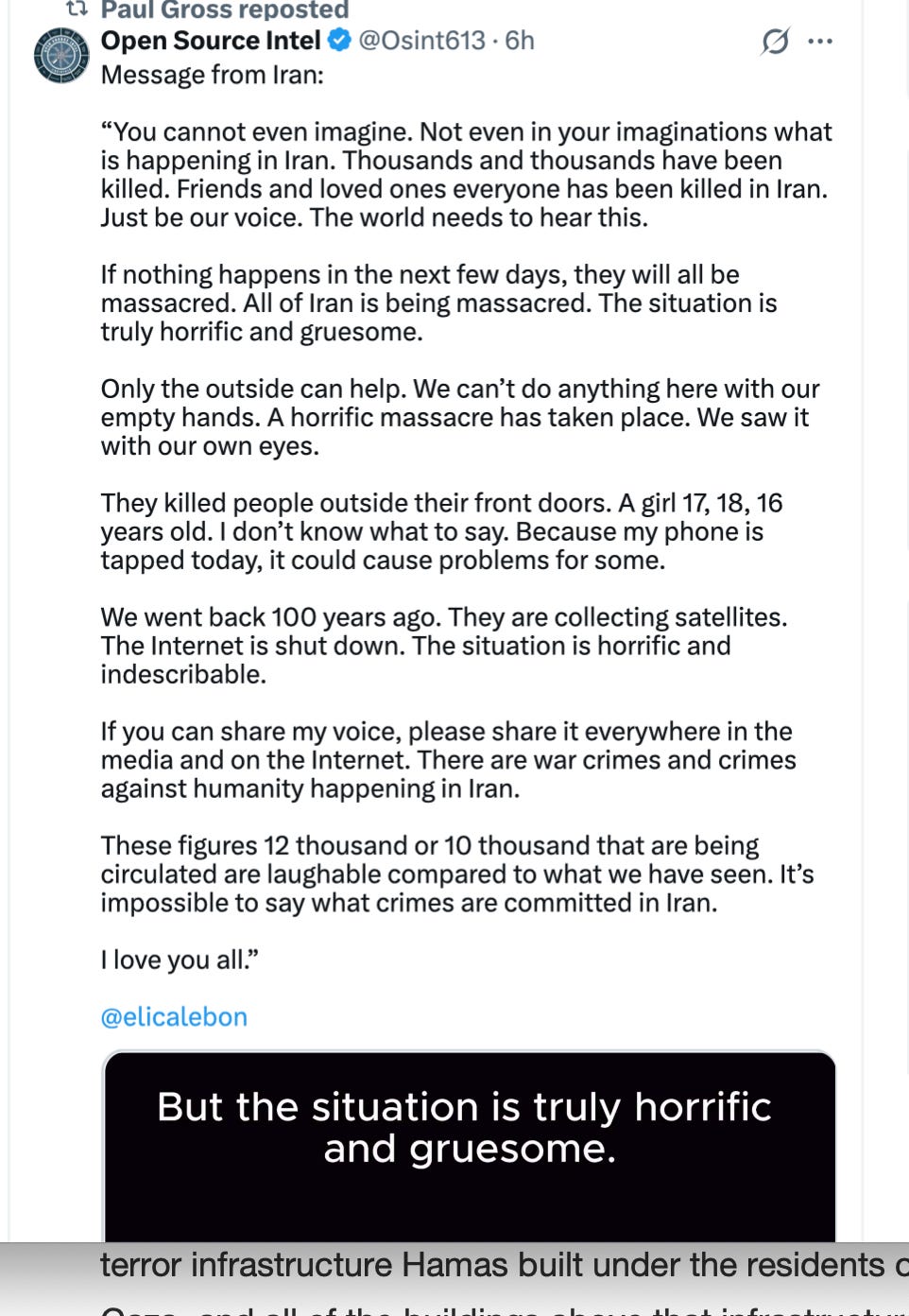
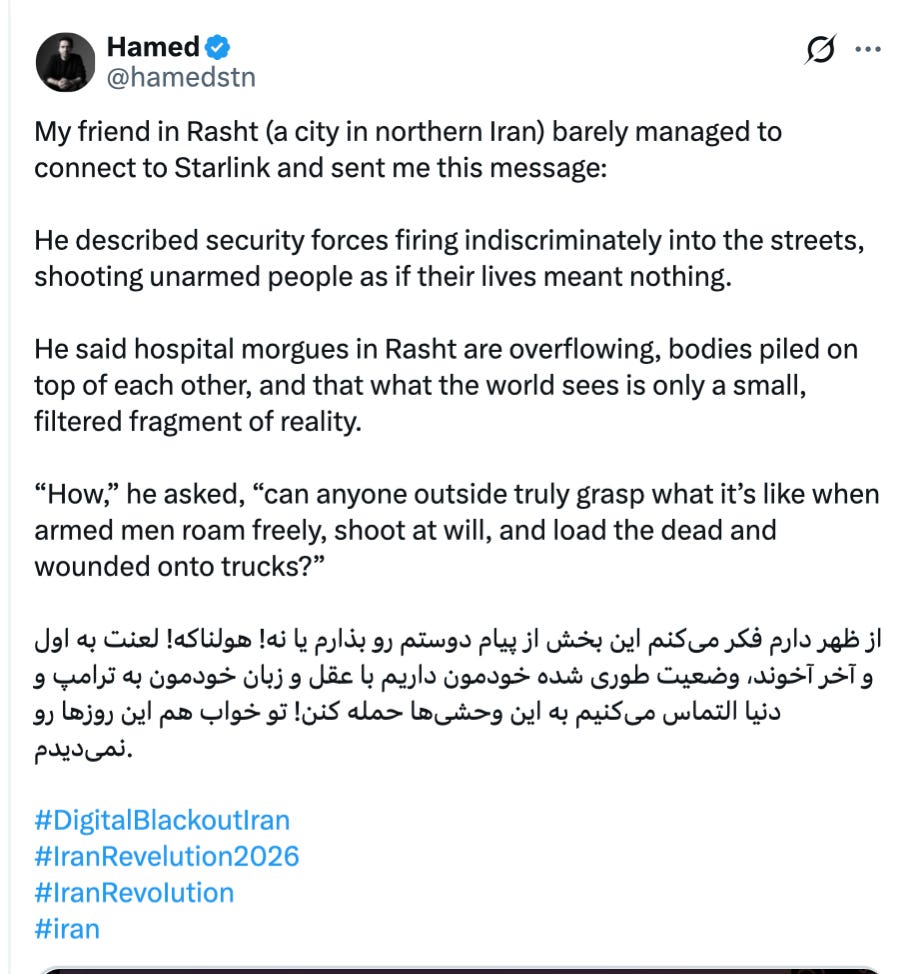
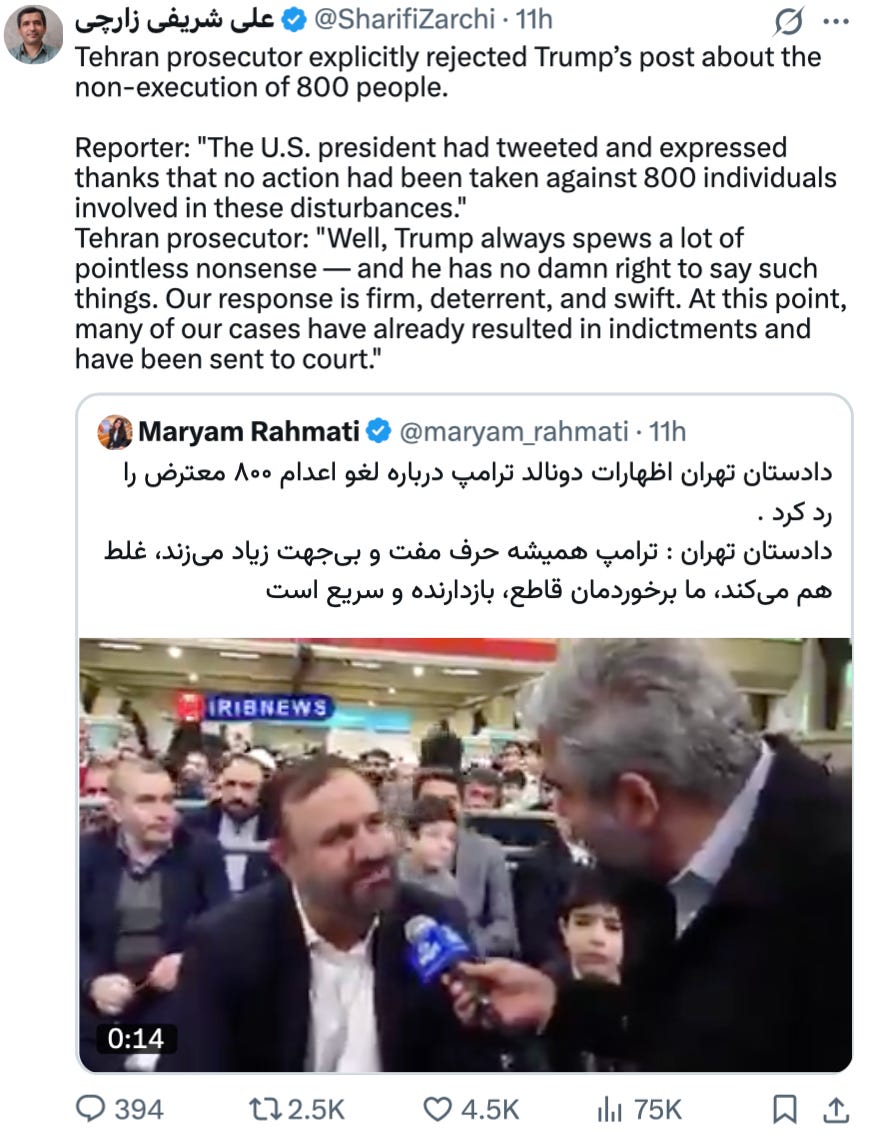
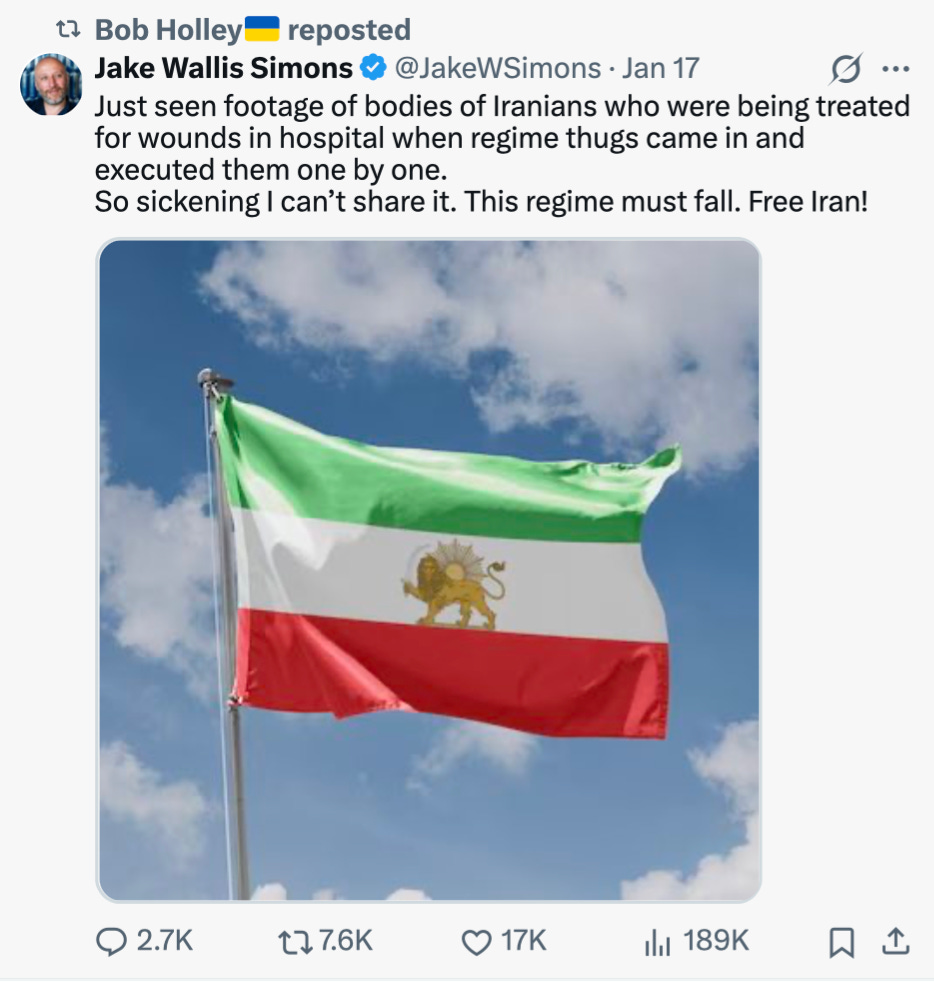
Former US ambassador to Israel Dan Shapiro:
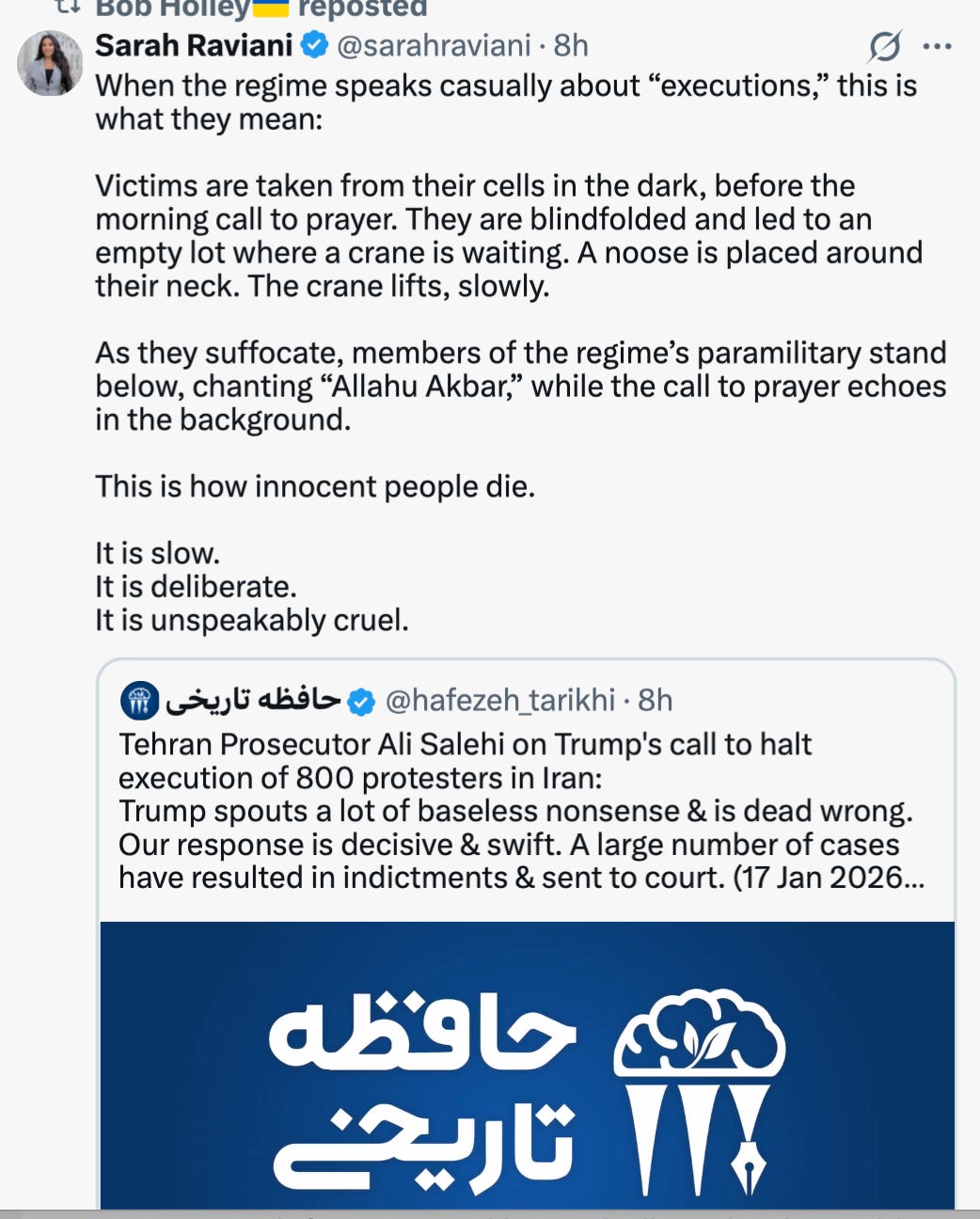
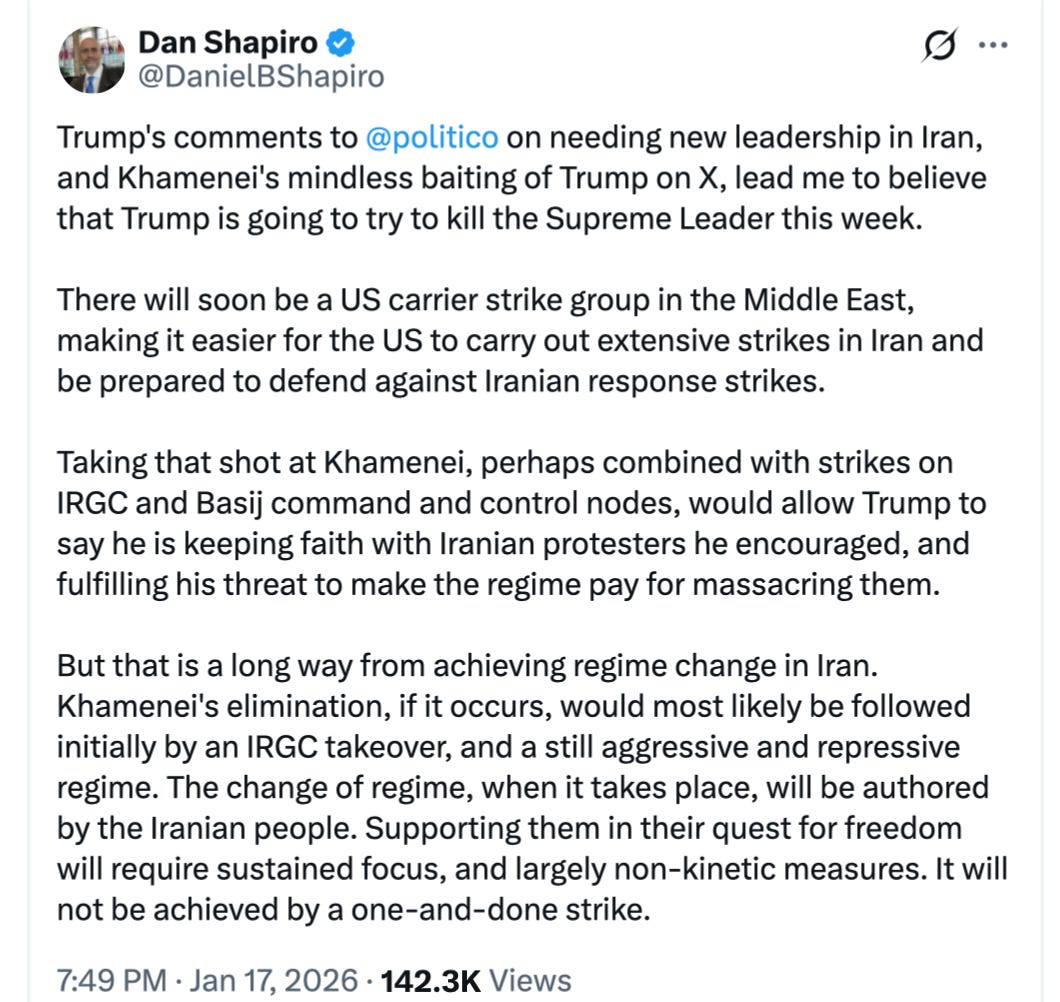
Israel fumes at Gaza oversight panel makeup as Trump invites Erdogan to peace board. Netanyahu’s office says it was left out of talks on makeup of executive board, which includes senior officials from Turkey and Qatar, who will report to Board of Peace panel of world leaders.
Trump’s administration wants nations to pay US$1 billion to stay on his Gaza Board of Peace for more than three years, according to the full text of the board’s charter. [Of course.]
Israeli officials harshly critical of Steve Witkoff’s influence on US policy on Gaza, Iran. “If it turns out that he is among those blocking a strike on Iran, that is far more than a coincidence”
Amid growing disagreements with the Trump administration over the composition of the Board of Peace for Gaza and the question of a strike on Iran, officials in Israel point to a key figure behind decisions seen as running counter to Israeli interests: Special Envoy Steve Witkoff.
The officials mention sustained dissatisfaction with Witkoff. Sources close to the PM Netanyahu told i24NEWS on Saturday evening: “For several months now, the feeling has been that envoy Steve Witkoff has strong ties, for his own reasons, across the Middle East, and that at times the Israeli interest does not truly prevail in his decision-making.” This criticism relates both to the proposed inclusion of Turkey and Qatar in Gaza’s governing bodies and to the Iranian threat. A senior Israeli official put it bluntly: “If it turns out that he is among those blocking a strike on Iran, that is far more than a coincidence.”
I’m not sure what to make of this, given the reporting that it was Israel that lobbied against striking Iran.
Syrian government forces enter northern towns after Kurdish fighters withdraw. Syrian government forces have entered two northern towns after Kurdish-led fighters agreed to evacuate:
… Over the past two days, more than 11,000 people fled Deir Hafer and Maskana using side roads to reach government-controlled areas, after the government announced an offensive to take the towns. On Friday night, after government forces started pounding SDF positions in Deir Hafer, the Kurdish-led fighters’ top commander, Mazloum Abdi , posted on X that his group would withdraw from contested areas in northern Syria.
The easing of tension came after US military officials visited Deir Hafer on Friday and held talks with SDF officials in the area. The United States has good relations with both sides and has urged calm.
The SDF’s decision to withdraw from Deir Hafer was made after al-Sharaa issued a decree Friday boosting the rights of the country’s Kurds,who made up about 10 percent of Syria’s population of 23 million before the conflict began in 2011. Over the past several decades, Syria’s Kurds have been marginalized and deprived of their cultural rights under the rule of the Baath Party that ran Syria for six decades until President Bashar Assad’s fall in December 2024.
Al-Sharaa’s decree recognized Kurdish as a national language, along with Arabic, and adopted the Newroz festival, a traditional celebration of spring and renewal marked by Kurds around the region, as an official holiday.
The Kurdish-led authority in northeast Syria said Saturday that the rights of Kurds should not be protected by “temporary decrees” but by mentioning them in the country’s constitution. It added that a decree “does not form a real guarantee for rights of Syria’s ethnic groups.”
Syrian forces are pushing Kurds out of the Aleppo area:
The SDF’s media center reported the Kurdish forces are “engaged in intense clashes” with the Syrian military and accused government officials in Damascus of violating a recent truce agreement.
“As a result of the Damascus government’s treachery and violation of the internationally sponsored agreement, groups of our fighters remain besieged in the towns of Deir Hafer and Maskana, despite the agreement stipulating a 48-hour deadline for our forces to withdraw,” the SDF said in an earlier post.
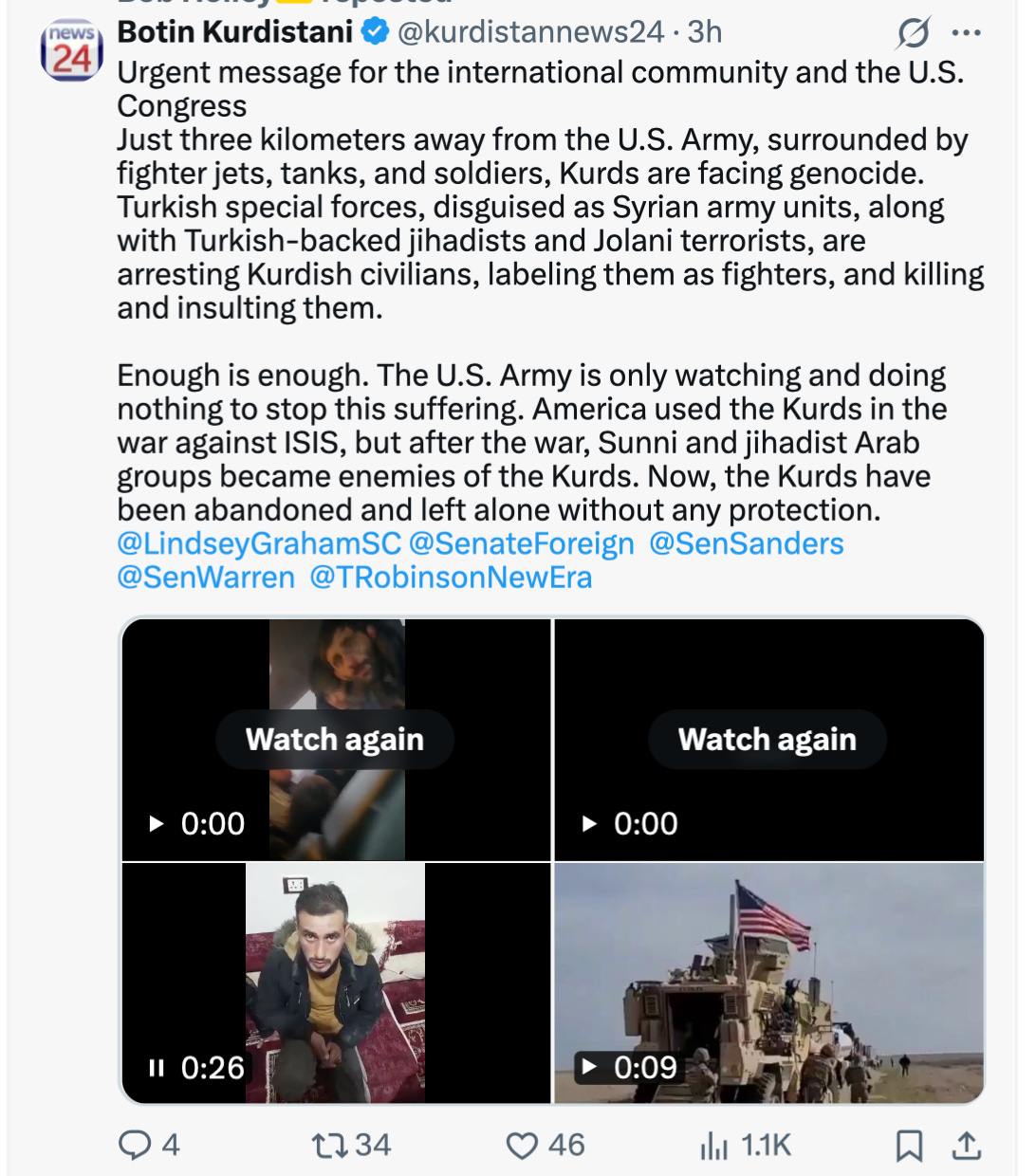
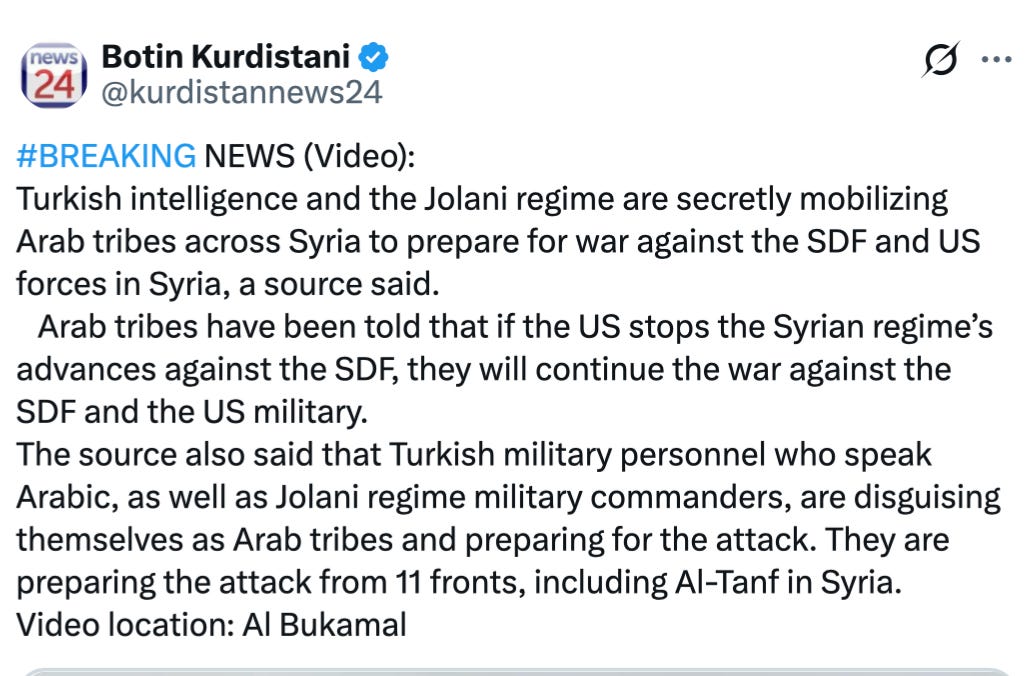
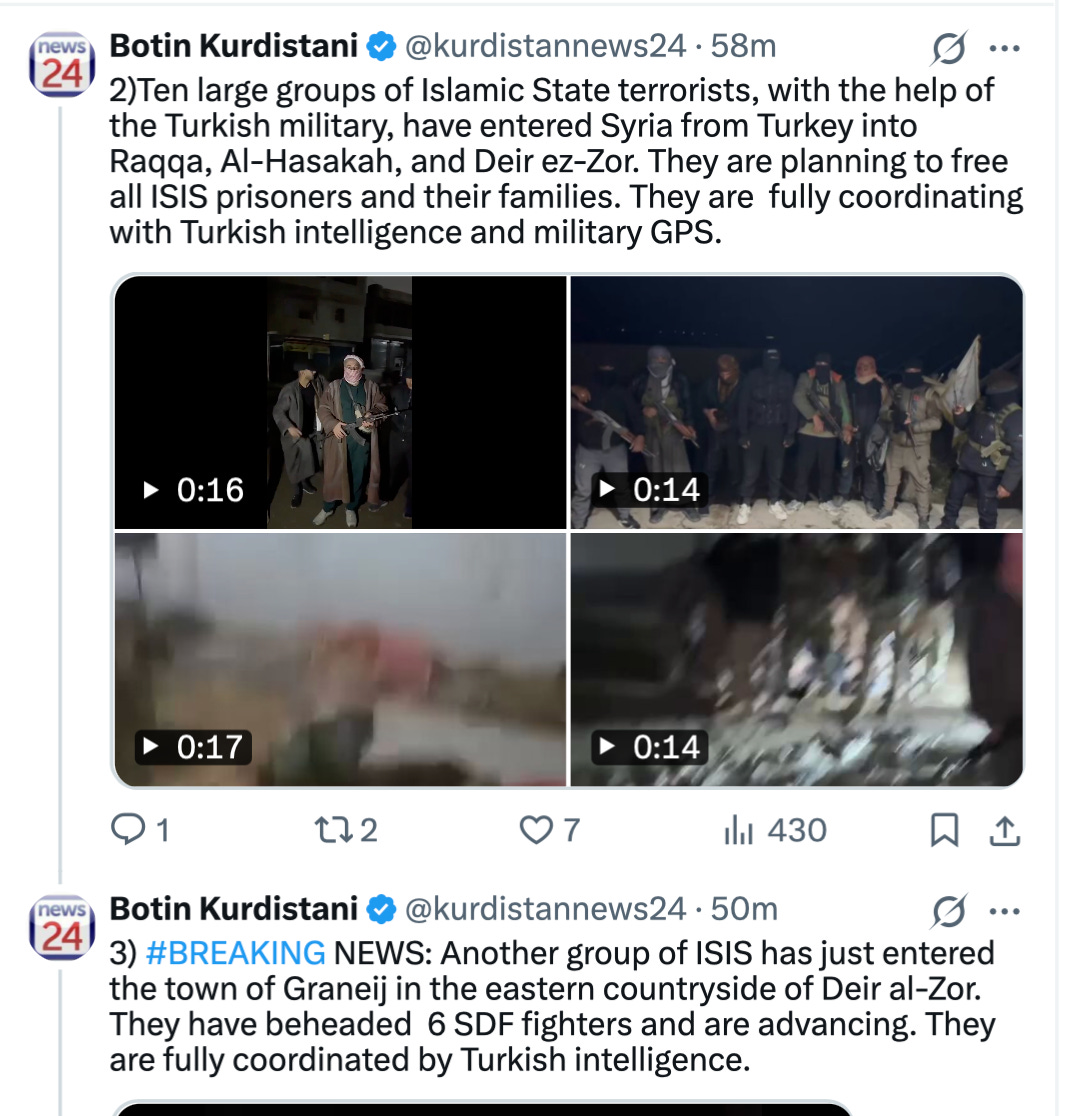
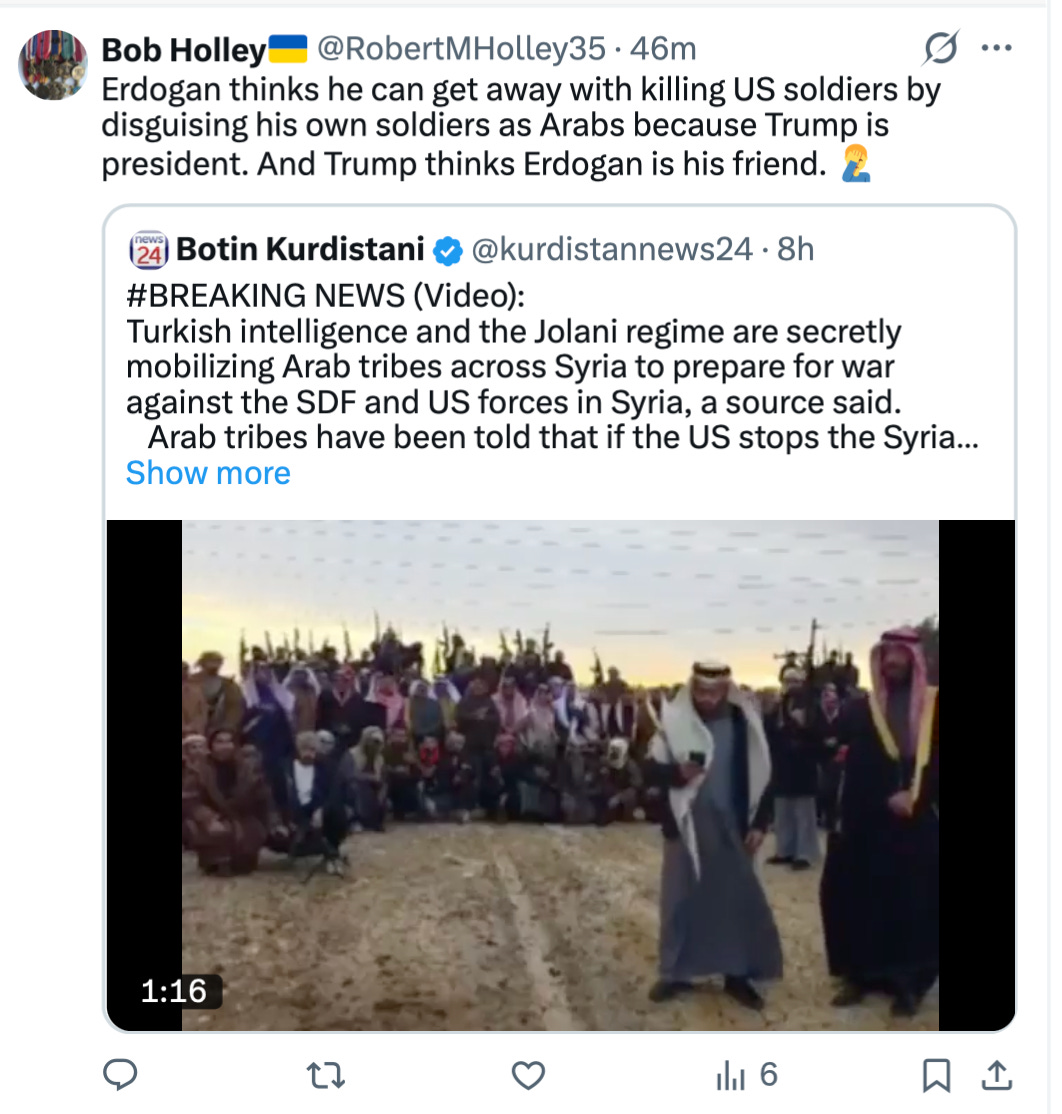
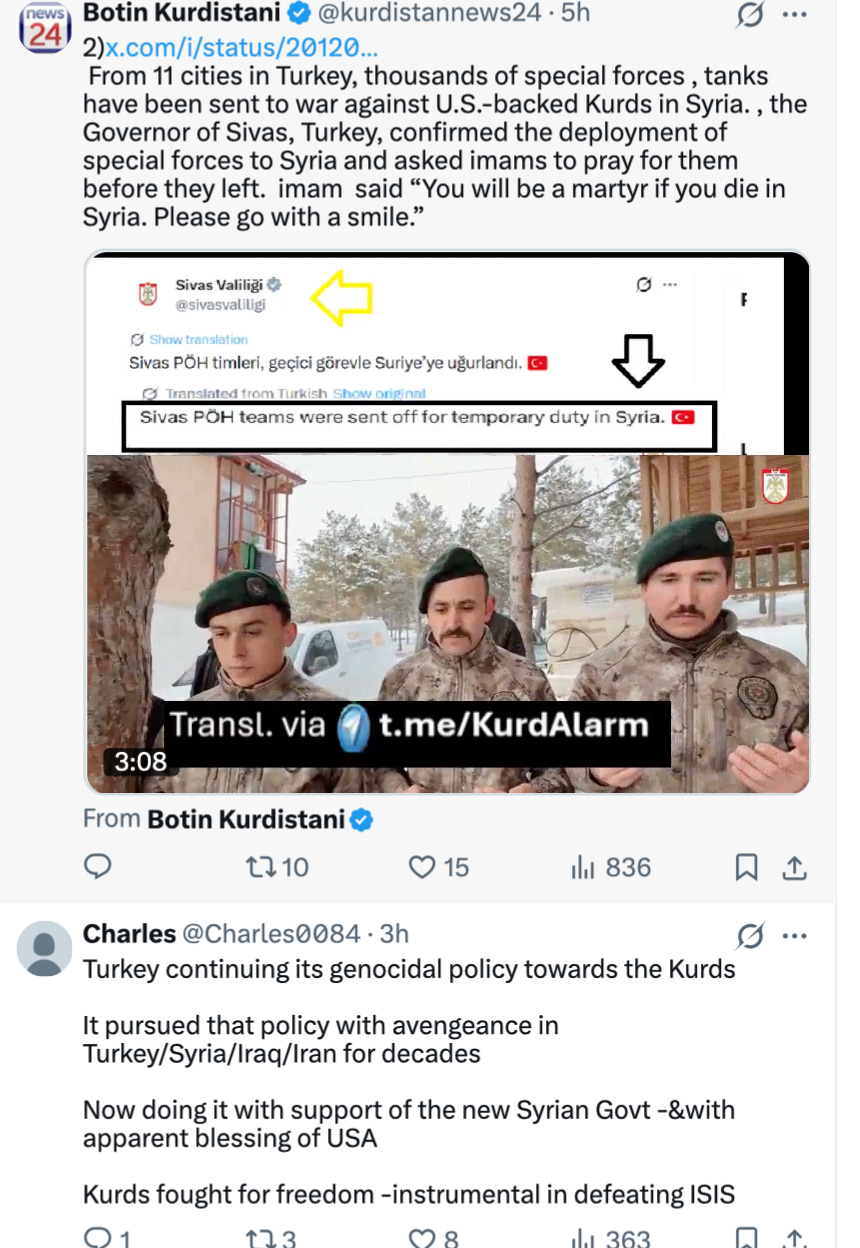
Obviously, I can’t assess the credibility of these reports. But they’re a priori credible. Have a look for yourself and tell me what you think.
Syria’s killing machine. A newly revealed trove of photos depicts 10,000 people who had died in Bashar al-Assad’s brutal prison system during his last decade in power. (This is not a new article, but it’s important.)
Syria-Lebanon ties tested by alleged Assad loyalists’ plots:
Lebanon and Syria have been working to turn the page on decades of mistrust and tense ties since the ouster of Syrian President Bashar Assad in December 2024. But the uneasy process has been complicated by reports that former regime officers hiding in Lebanon were involved in plots against Damascus’ new leadership. The alleged use of Lebanese territory to destabilize Syria and undermine the rule of its new president, Ahmad Sharaa, has emerged as a highly sensitive security issue, raising concerns in the two neighboring countries.
The reports were based on leaked audio recordings obtained by Al Jazeera of former Assad loyalists, including high‑ranking military officers, discussing plans to regroup, secure funding and weapons, and explore possible coordination with Israel to undermine Syria’s stability after the collapse of the Assad regime.
They were specifically considering military action involving remnants of the former regime’s forces in Syria’s coastal regions to regain influence, particularly in Alawite-majority areas. The most alarming part was the alleged establishment of an operations command cell in Lebanon by Suhail al‑Hassan, Syria’s former special forces commander, widely feared for violently suppressing protests and ordering air strikes against civilians during the civil war.
Concerns about the alleged plot prompted the Lebanese Army, military Intelligence and other security services to conduct raids in northern Lebanon, including searches in areas with Alawite villages and camps hosting Syrian refugees, as well as in a camp recently established by Hezbollah in the town of Hermel that houses displaced Syrian Alawite families.
I can’t keep looking at the news. It’s making me want to vomit. We’ll talk about all of this tomorrow.
