

The Believers
The Islamic Republic, Khomeinism, and the End of History

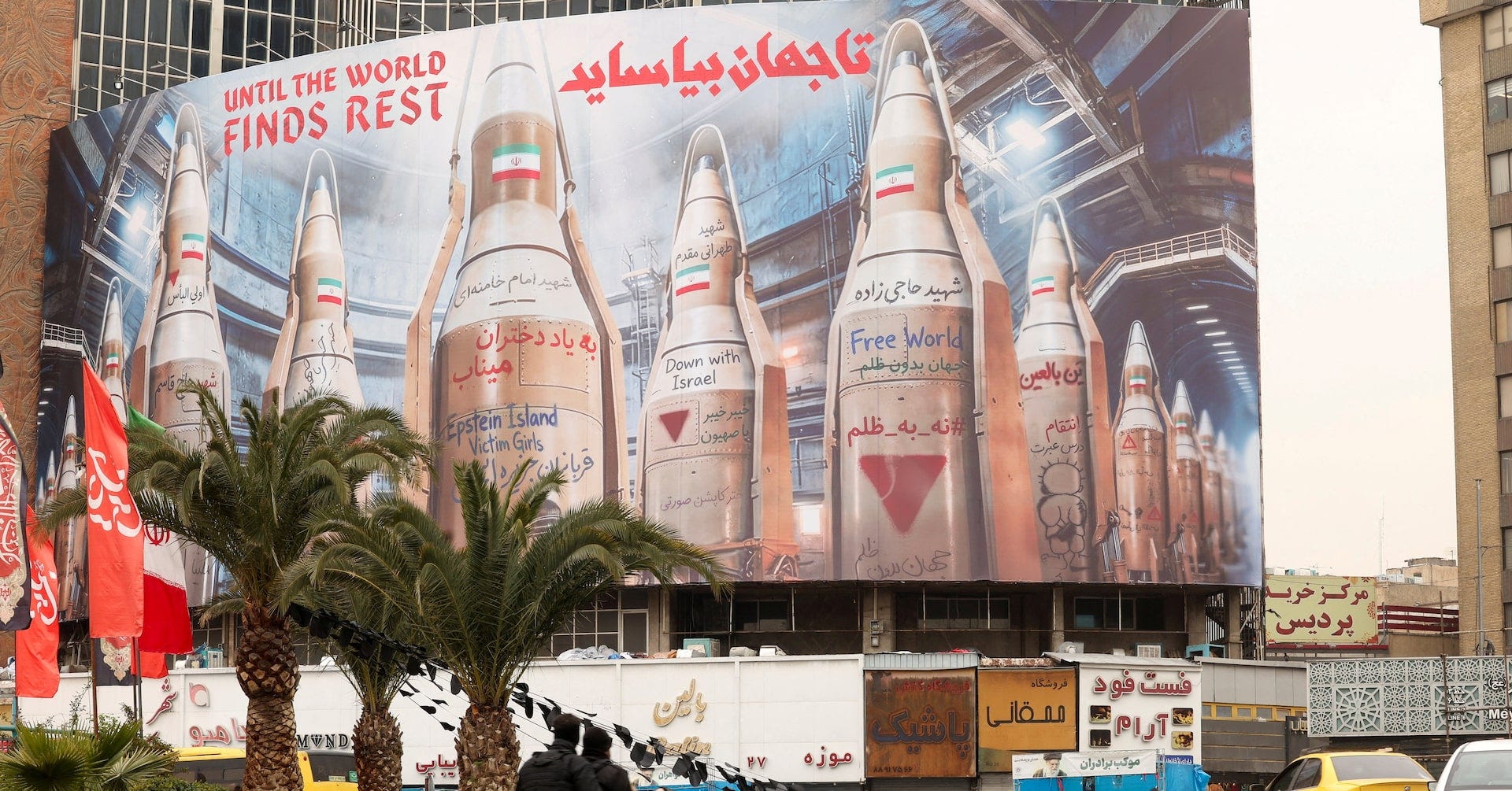
Have a look at the photo above, a billboard recently spotted in Tehran. The red slogan in the center, :تا جهان بیاساید , is the Persian translation of the English words, “Until the world finds rest.”1 The missiles say:
شهید امام خامنهای — “Martyr Imam Khamenei”
به یاد دختران میناب — “In memory of the girls of Minab”
شهید طهرانی مقدم — “Martyr Tehrani Moghaddam”
شهید حاجیزاده — “Martyr Hajizadeh”
شهید قاسم — “Martyr Qasem”
جهان بدون ظلم — “A world without oppression/injustice”
#نه_به_ظلم — “#No to oppression/injustice”
انتقام — “Revenge”
درس عبرت — “A lesson.” (Or “an object lesson” or “a warning”)
Note the themes of martyrdom, redemptive struggle against injustice, and the rectification at the end of history. These are a quintessentially Shiite triad. But the militarization of this triad is distinctively Khomeinist.
“UNTIL THE WORLD FINDS REST” are the most important words on the billboard, and they’re doing enormous theological work. They’re ominous enough on the face of it, but far more so in the context of revolutionary Shia eschatology. The world is restless because injustice reigns, and injustice reigns because the enemies of God and righteousness prevail. The world will only find rest when the Mahdi—the “Rightly Guided One”—returns at the end of history, vanquishing evil and ushering in Islamic rule. The billboard is, therefore, an exhortation to struggle in a conflict that is both cosmically necessary and inevitable. The current war, it suggests, belongs to a struggle that ends only with the eschatological consummation.
“A world without oppression/injustice” is another significant phrase. The Persian-Arabic word ظلم (zulm) is richer than the English word “oppression.” It denotes the state of the world under illegitimate rule, which it has been, or so Shiites believe, since the battle of Karbala in 680 CE—the pivotal confrontation in Islamic history, when the Umayyad army massacred Husayn ibn Ali and his small band of followers. The word zulm connotes tyranny, moral disorder, usurpation, things where they don’t belong.
In Shia history, the paradigmatic zulm is the usurper—the tyrant who rules against God’s moral order, who wrongs the Prophet’s family, and persecutes the just. Within this symbolic world, resistance to zulm is a sacred duty. The Islamic Republic uses this word to describe Israel, the United States, hostile Arab states, and internal dissidents. We are embodiments of zulm.
“Down with Israel” has a specific theological significance. For Khomeneists, Israel’s destruction is an eschatological goal, not just a geopolitical one, because Israel’s destruction is the precondition for the Mahdi’s return. Similarly, انتقام (revenge) refers to the cosmic settling of accounts that will precede the restoration.
Note the way recent events are folded into the symbolic order of Karbala. For Shia, martyrs aren’t dead. They testify. Their blood speaks. The blood of the girls of Minab speaks, as Husayn’s blood is said to do. Dead children are testimony against ظلم, confirming the righteousness of the cause. The juxtaposition of the Minab girls with the “Epstein Island Victim Girls” is quite theologically precise: For Khomeneists, America isn’t merely the great usurper, it’s also the great corruptor, the emblem of sexual licence and moral subversion. The Epstein saga is proof of this. There is an implicit argument here: “They exploit their girls. We avenge ours.” Similarly, naming weapons for martyrs connects the military project directly to the drama of Karbala. The missiles continue the martyrs’ testimony, proving that the shahids didn’t die for nothing. Their names are literally aloft, soaring toward Israel.
Tehrani Moghaddam was the father of Iran’s long-range ballistic missile project. He was killed in 2011 in a not-so-mysterious explosion at an IRGC military base. Moghaddam’s finest protégé, Major General Amir Ali Shahid Hajizadeh, was killed in June 2025, when Israel struck his underground IRGC command center. Together, the names are a lineage—a martyrological chain.
“Free World,” of course, is a term from the West’s Cold War vocabulary. The phrase is held at arm’s length, here, with visible contempt. In Khomeneist eyes, this term is one of the most successful pieces of Satanic propaganda ever devised: a slave order that calls itself freedom, a corrupting power that calls itself liberation. Putting those words on a missile destined for Israel is a taunt, obviously, but it’s also a theological rebuttal. By placing the words alongside their Farsi translation جهان بدون ظلم—“a world without oppression”—the billboard says: “You call yourselves the Free World. But we’re going to show you what a world without oppression really means. It will arrive on this missile.” The actual free world—جهان بدون ظلم—is precisely what the Mahdi will inaugurate upon his return. Your “Free World” is the reign of ظلم. Ours is what comes after.
The inverted red triangle is a Hamas symbol: It indicates something marked for destruction. The hashtag before #نه_به_ظلم (“#No to oppression/injustice”) is a sardonic allusion to Western social media culture and the digital vocabulary of liberal activism (#BringBackOurGirls, #StandWithUkraine). The implication is that the Great Satan has seduced the world into thinking that by typing a phrase into a phone, it can rectify injustice. Our انتقام, this says, is rather more concrete.
The authors of the text on the billboard obviously have a sense of their Western audience. They imagine that they’re speaking to us directly, in our own idiom. We’re meant to understand it. But of course, we don’t. No one in the West pays this kind of thing the slightest bit of attention, and this the strangest aspect of our long conflict with the Islamic Republic. For 47 years, it has made its beliefs and its goals unambiguous. What’s more, the behavior of the regime has been consistent with what it claims to believe. But the West just refuses to take any of this seriously. In all of the reporting you’ve seen on this war, have you seen even one article discussing the Mahdi? I haven’t.
It’s as if, during the Cold War, we simply refused to believe that our adversaries were communists, refused to read a word of Marx, and never once considered that Soviet leaders might be serious about building a socioeconomic order based on the common ownership of the means of production, distribution, and exchange. Imagine trying to figure out what Stalin was doing without understanding the concepts of historical materialism, class war, the dictatorship of the proletariat, the vanguard party, or the laws of revolutionary development. Imagine insisting that Bolshevism was just a decorative vocabulary draped over ordinary Russian nationalism, or a kind of theatrical language no one was meant to take literally.
We never talked ourselves into such stupidity. We understood that Marxism-Leninism was not incidental to the Soviet project; it was the project. You didn’t have to think that Marx was right to grasp that the men in the Kremlin believed he was, and to grasp that this was essential to understanding their behavior.
But this is exactly the error the West keeps making with the Islamic Republic. We strain to explain its conduct in the terms modern Western elites find respectable: deterrence, regime survival, Realpolitik. Yes, all of those things matter. Iran isn’t exempt from strategic calculation. But the leaders at the core of the Islamic Republic are fused to something else: a theology of history, a cult of redemptive suffering, a metaphysical understanding of injustice, and a set of eschatological expectations that aren’t peripheral to their behavior, but the motivation for everything they do.
Khomeinism isn’t a cynical veneer over an otherwise conventional state. Certainly, yes, some actors in that regime, perhaps many, are disillusioned and cynical. But not all of them. Khomeinism instructs the Islamic Republic’s elites, particularly the IRGC, in the meaning of history. It teaches them that the longed-for redemption of history will emerge, and can only emerge, through struggle, catastrophe, and blood.
To ignore all of this isn’t sophistication. It’s just smug illiteracy. The ideological universe the regime inhabits may be unfamiliar, but it’s not inaccessible, particularly now that machine translation and AI have collapsed the language barrier. You can learn the basics, for free, from this volume of speeches and writings by the Ayatollah Khomeini. Islamic Governance, published in 1970, is to the Iranian Revolution what The Communist Manifesto was to the Russian Revolution.
His treatise has been incorporated into the Islamic Republic’s constitution. From the preamble:
… In the flow of its revolutionary evolution, our nation was cleansed of the dust and rust of the reign of decadence; it cleansed itself of the intellectual alien impurities. It returned to the authentic Islamic worldview and intellectual positions. Now it is determined to establish its exemplary model society (iswa) based on Islamic criteria. On these bases, the constitution’s calling is to actualize the ideological premises of the uprising and to create conditions where one can be raised with the exalted universal Islamic values.
With respect to the Islamic content of the Iranian Revolution, which was a movement for the victory of all the oppressed people over their oppressors, the constitution prepares the ground for continuing this revolution at home and abroad. Specifically, it strives to expand international relations with other Islamic movements and people in order to pave the way for the formation of a single, universal community, in accordance with the Qur’anic verse, “Verily, this Brotherhood of yours is a single Brotherhood, and I am your Lord and Cherisher: therefore Serve Me (and no other)” (21: 92), to also assure that the continuous struggle for the emancipation of the deprived and oppressed nations of the world is strengthened.
… In establishing and equipping the defense forces of the country, the focus shall be on maintaining ideology and faith as the foundation and the measure. Consequently, the Army of the Islamic Republic and the Islamic Pasdaran Revolutionary Corps are formed in accordance with the aforementioned objective. They will undertake the responsibility of not only guarding and protecting the borders, but also the weight of ideological mission, i.e. striving (jihad) on the path of God and struggle on the path of expanding the sovereignty of the law of God in the world; in accordance with the Qur’anic verse: “Against them make ready your strength to the utmost of your power, including steeds of war, to strike terror into (the hearts of) the enemies, of Allah and your enemies” (8: 60).
Americans are having a noisy debate about the conduct and wisdom of our war in Iran, and rightly so. But the solipsistic and impoverished quality of this debate is disheartening. We seem to think the regime’s theology is irrelevant and its propaganda is some kind of kitsch. The Islamic Republic’s ideology should be central to our analysis. Because it is not, we insist on negotiating with its leading figures as though they were technocrats from Brussels. Then, absurdly, we’re surprised when they do exactly what they’ve been saying—slowly, loudly, and for nearly half a century—that they intend to do.
Martyrdom, the Schism, and the Imam
A particular religious story, central to Shiism for fourteen centuries, is the organizing principle of the Islamic Republic’s foreign policy, military doctrine, and understanding of its own historical purpose. To make sense of the regime’s behavior, we need to know this story, because it makes the regime’s behavior not only intelligible but, in its own terms, inevitable. In the eyes of the regime, its confrontation with Israel and the United States represents the unfolding of a divine plan whose shape has been known to Shiites for over a thousand years.
The central drama of Shi’ism is Imam Husayn’s martyrdom at Karbala. Karbala is the paradigmatic revelation of the truth about this world, and that truth is that the righteous are often outnumbered and defeated. Truth is stifled. The righteous are called to suffer, witness, and die rather than submit to illegitimate rule. Terms like شهید (“martyr”), ظلم (“oppression,” “injustice,” and “wrongful domination”), انتقام (“revenge” or “vengeance”) are all part of this Karbala-saturated symbolic order. Suffering, in this worldview, is not absurd; it plays a key moral role.2
The Sunni-Shia schism was, fundamentally, about succession: Who would lead the community after the death of the Prophet, in 632 CE? For Shiites, the answer was the Prophet’s family, beginning with Ali. This is the line of Imams—divinely guided figures, living proof of God’s continued involvement with humanity.
According to Twelver belief, the twelfth Imam was a child when, after his father’s death in 874, God placed him in occultation—hidden from the world, though still alive. For a time he communicated through trusted deputies; then he passed into a deeper concealment that, believers hold, continues to this day. He will return at the End of Time as the Mahdi. For 1,150 years, a significant portion of humanity has been organizing its spiritual life in anticipation of his eventual return.
The story of the Twelfth Imam, therefore, begins in catastrophe and opens onto hope. The child who should have inherited the mantle of sacred authority doesn’t ascend a throne, lead an army, or found a dynasty. He is first hidden but still dimly accessible, then hidden altogether, absent from the eye, but not from the world. He’s Schrödinger’s Imam: gone and not gone, lost and not lost, dead to ordinary history but alive to divine time. His return will be preceded by chaos, injustice covering the earth, and specific prophesied events—including the destruction of a Jewish polity.
What gives the story of the 12th Imam its emotional force is that it turns bereavement into a form of faithfulness. Long before the Twelfth Imam entered occultation, his followers had learned to see history as a record of betrayal: the Prophet’s house displaced, his heirs hunted, humiliated, and murdered. Their grief was not born from a single catastrophe alone, but from the sense that justice had been denied again and again, until absence itself became the signature of the sacred.
Shiʿism is, therefore, a tradition steeped in memory of dispossession. The Occultation gathers all of that sorrow into a single image: justice hasn’t died; it has gone underground. The Imam is hidden because the world is unworthy of him; history is an age of eclipse. The Imam is absent, but not defeated. He remains the latent guarantee that injustice will not have the final word. To live as a Twelver is to inhabit a spiritual mood that is at once mournful and expectant—to grieve, to endure, to wait.
The world, in this telling, is not simply unjust; it is out of joint because its rightful guide has been taken from view, withheld by God from an age too brutal, too corrupt, too blind to receive him. We live, in this vision, in an interlude: a long twilight between betrayal and restoration.
This arcane theological history matters urgently right now. We are in a war whose origins and logic are, in most of the world, misunderstood.
The Revolution Within the Revolution
It is critical to grasp that the mainstream Shia clerical response to the Occultation was political quietism. If you don’t realize this, you might mistake Khomeini for a familiar type. He is not. He’s a radical innovator within his own tradition, a true revolutionary.
A distinctly Marxist influence on his doctrines arrived, inter alia, through the figure of Ali Shariati, a revolutionary sociologist from a clerical family, educated in Paris, who called for a “Red Shiism” that actively struggled against oppression, as opposed to the “Black Shiism” of mourning. Khomeini’s ideas belong firmly to the 20th century. It is impossible to make sense of them absent the context of modernity and the West.
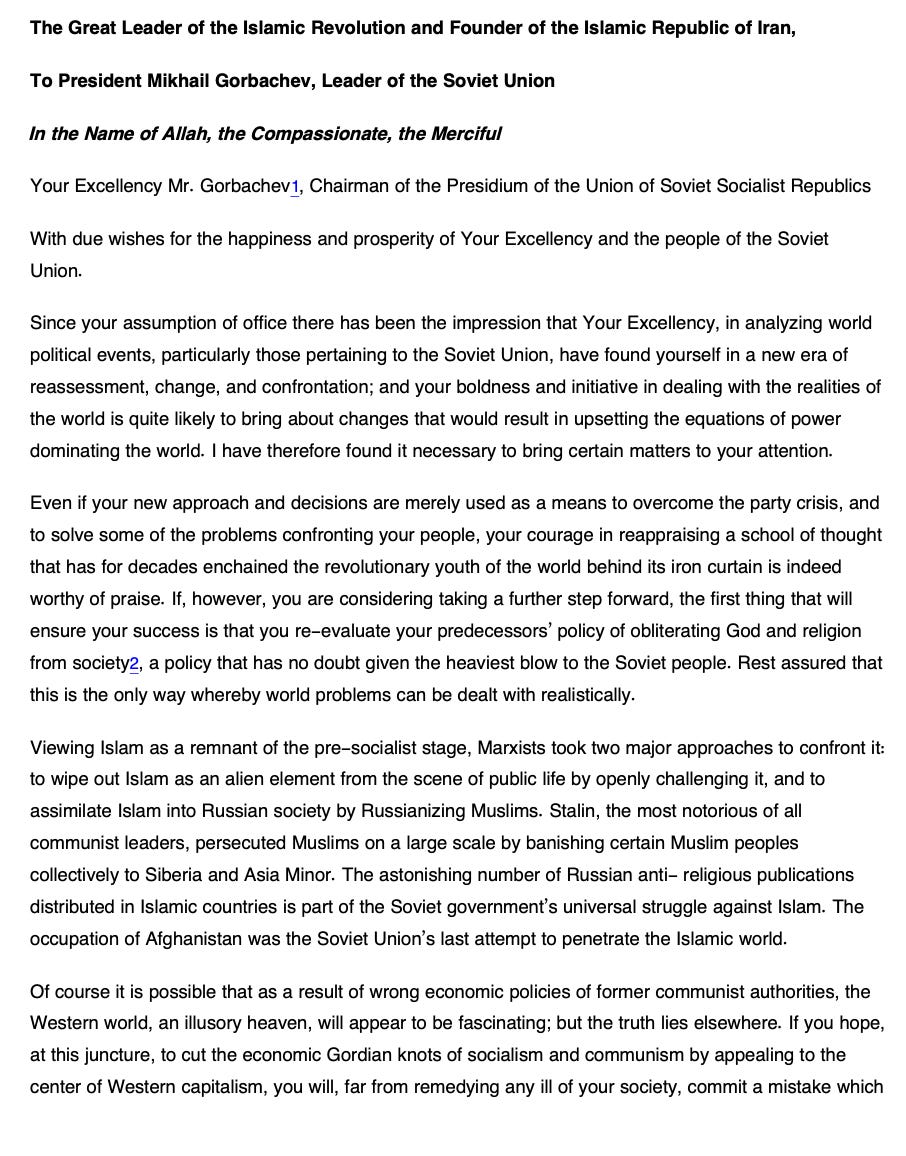
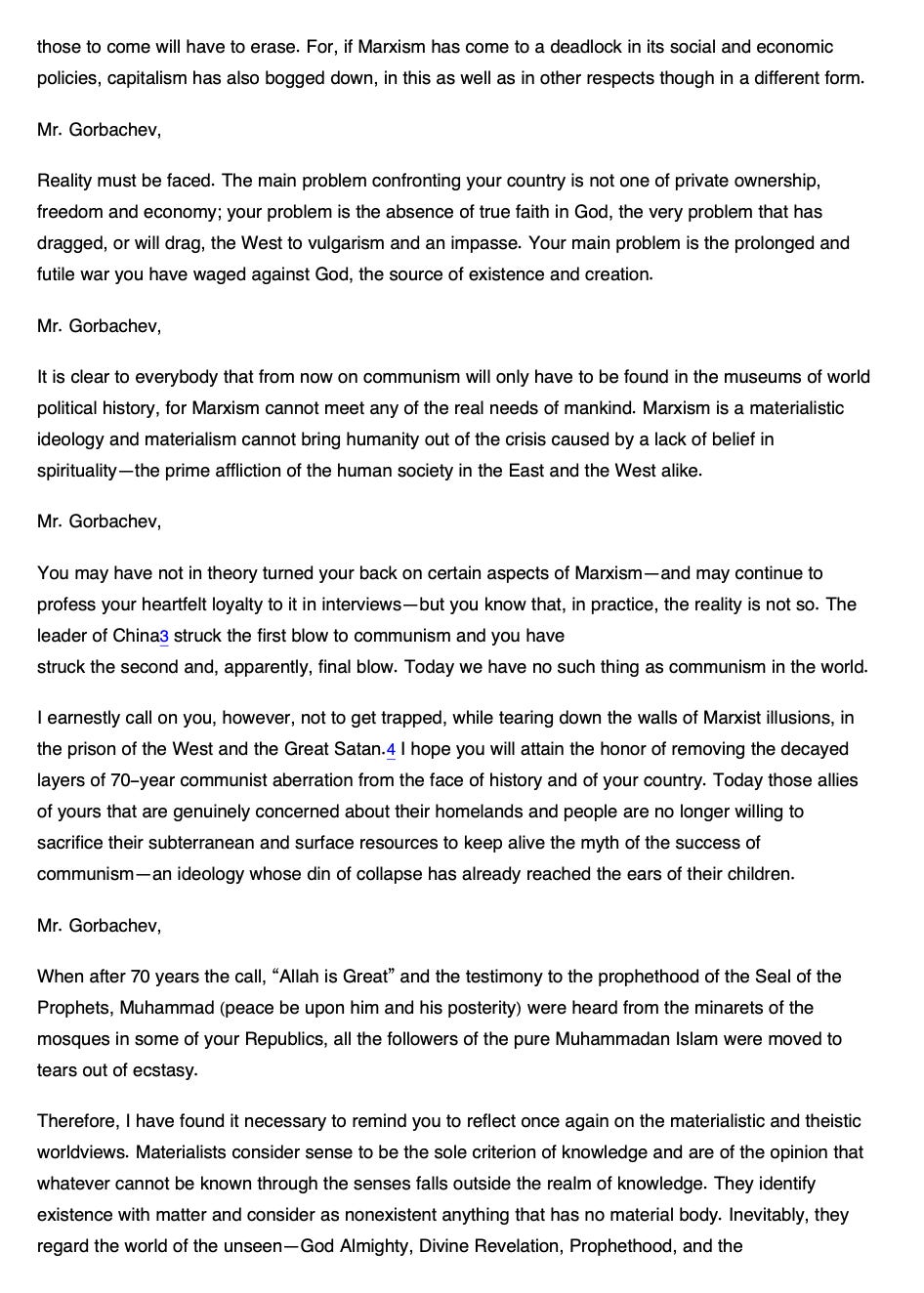
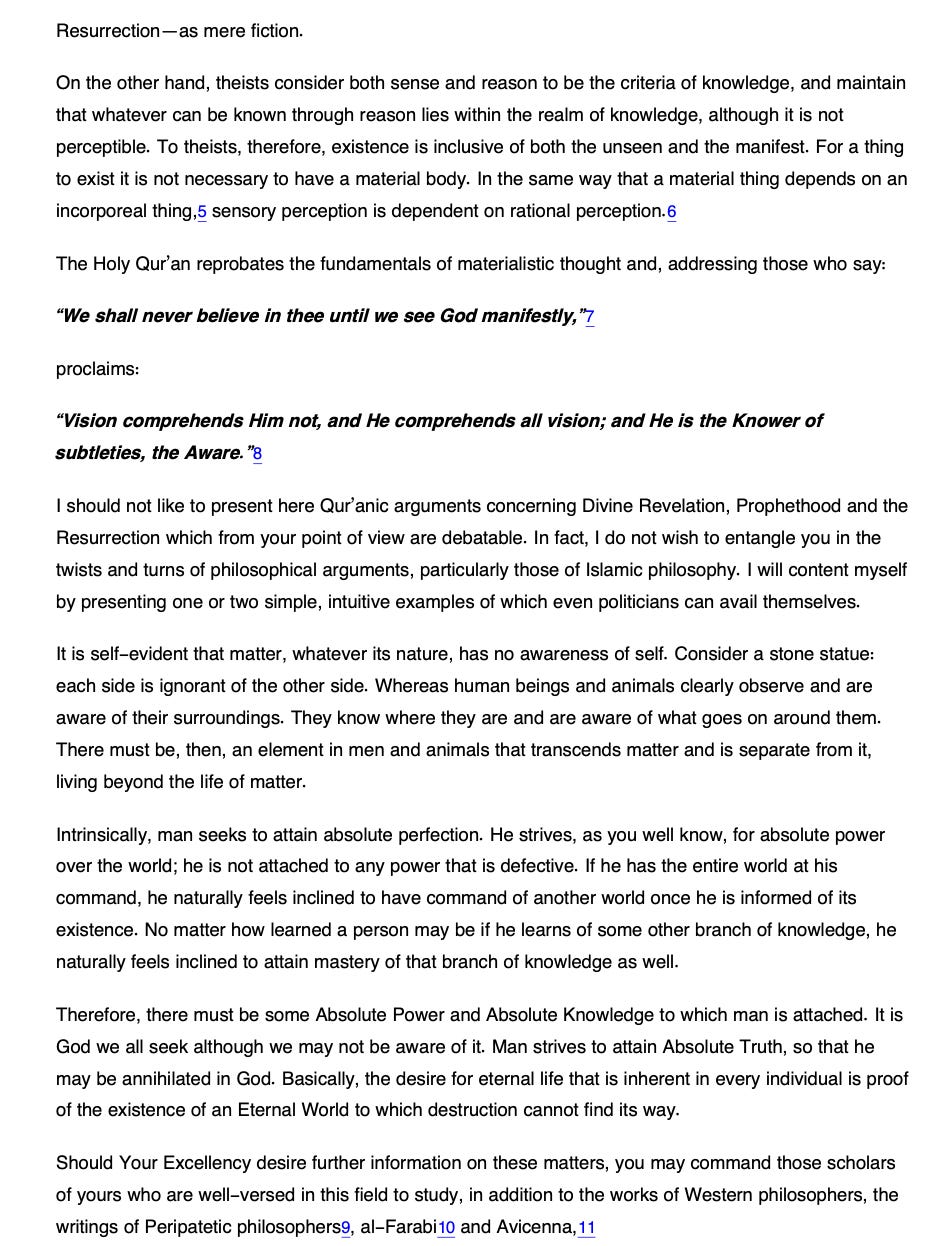
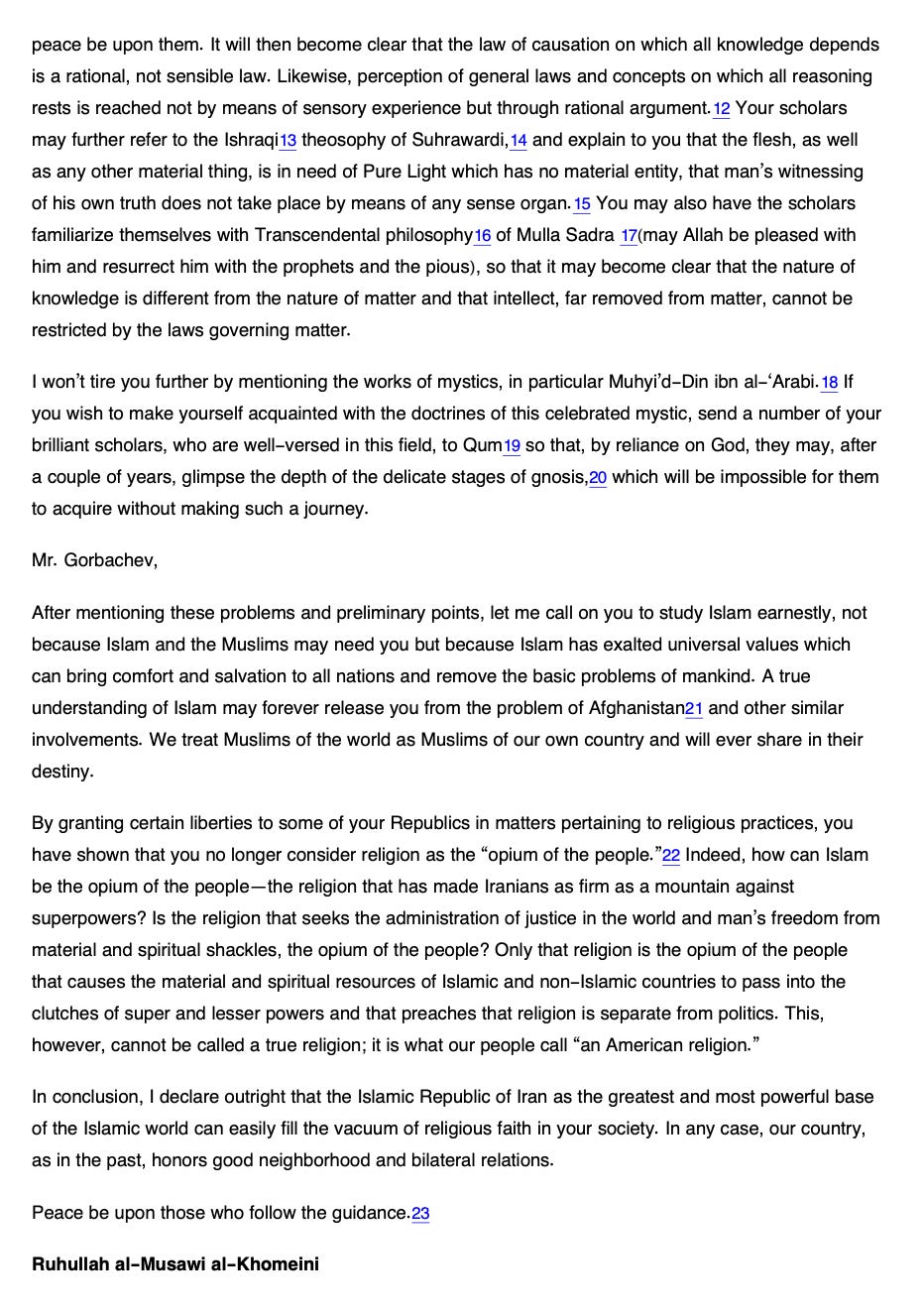
Every bit as much as Lenin, Khomenei envisioned himself as the leader of a global revolution. If Lenin concluded the revolution would be advanced by a proletarian vanguard, Khomenei concluded it would be advanced by a Shiite vanguard. In 1989, Khomeini sent Gorbachev a letter. It is a remarkable document. He tells Gorbachev that communism is exhausted and Islam will fill the void. It reveals the genuinely universalist, world-historical scope of his vision.3
Traditional Shi’i scholars concluded from the Occultation that precisely because the true Imam was absent, religious authorities should stay out of politics. Don’t mistake any worldly ruler for the hidden one. Don’t try to hasten what God will bring. Wait. Purify. The Grand Ayatollah Sistani—still alive, still in Najaf, still the most authoritative Shia cleric in the world—is a living embodiment of the quietist tradition. He has consistently refused to claim political authority, even as Iraq collapsed around him. The contrast with Khomeini couldn’t be sharper.
Khomeini’s revolution was as theologically radical as it was politically radical. To understand it, you have to understand a theological tension in premodern Twelver Shi’ism: If the rightful Imam is absent, how much should clerics rule? Wilayat al-Faqih (Guardianship of the Jurist) is Khomeini’s answer to the question. In the Imam’s absence, the most qualified jurist should rule. That jurist’s authority is divinely sanctioned, and what’s more, it is necessary.
The Islamic Republic is no mere theocracy, in this view. It’s a placeholder for the hidden Imam. This means Wilayat al-Faqih isn’t just a political theory. It is an eschatological vision. The clerical state will be the vehicle for creating the conditions for the Mahdi’s return, and it derives its legitimacy from this role. Khomeini didn’t just politicize Shi’ism, he eschatologized politics, turning the state itself into an instrument of End Times theology. In doing so, he repurposed all of Shi’ite history to galvanize a revolution and legitimize a revolutionary state, transforming the Occultation from an age of tragic waiting to one of militant guardianship, ideological mobilization, and state-building.
Although its theology assigned martyrdom a central place, classical Shiism venerated suffering and steadfastness. Under Khomenei, the Islamic Republic transformed martyrdom into an engine of revolutionary political mobilization. During the Iran-Iraq war, a visual and ritual aesthetic of martyrdom took shape—it involved posters, murals, funeral iconography, operation names, missile dedications, mass rites. All of this taught a moral: Death, in the proper cause, is holiness. This form of holiness was nationalized and bureaucratized.
Shia devotional life has always emphasized avenging Husayn. But the Khomeneist interpretation of Shi’ism converted a tradition of redemptive suffering into a doctrine of redemptive violence. The word انتقام (“revenge,” “vengeance”) is central. Vengeance, in this view, is literal, military, nationalistic, and immediate.
VS Naipaul’s Among the Believers remains the most extraordinary description of Iran after the revolution. What he captured brilliantly was the psychological dimensions of this—the way revolutionary Shi’ism offered its adherents a total explanation of history and a heroic role within it. His portrait of the mostazafin (the dispossessed) finding cosmic dignity in Khomeini’s framework is still unsurpassed in English. (His 1998 follow-up, Beyond Belief, is worth revisiting too: by then, he’s seeing the contradictions and disappointments more clearly.)
The rhetoric of endless struggle “until the world finds rest” reflects this worldview. So do the missiles on the billboards. Missiles lend themselves especially well to this symbolic world because they descend from above with retribution, and they can be displayed like relics, or icons. They’re perfect for a regime that fuses anti-imperial grievance with eschatological promises and a martyrdom cult.
The Satan Theology
To grasp why the regime is so focused on Israel—or on Jews, more properly, because it doesn’t really distinguish—we need to understand what it means when it speaks of the Great and Little Satan. The Great Satan-Little Satan discourse is widely quoted and poorly understood.
Shaytan, in Islamic theology, is not the horned figure of Christian imagination. He is, primarily, a corrupter and deceiver: He is the one who whispers, who leads the faithful astray from the straight path. His weapon is seduction, distraction, the introduction of fitna (discord and corruption) into the umma.
When Khomeini called America the Great Satan, it was a theological diagnosis. The danger of America wasn’t primarily military; it was cultural and spiritual. Hollywood, consumerism, sexual freedom, and secularism were Satan’s instruments for luring Muslims away from Islam. The Shah was Satan’s local instrument; he was Westernizing Iran, corrupting its youth, replacing Islamic values with American ones.
Israel is the Little Satan not because it’s less important, but because it operates at closer range. It is, for Khomeini, a Western colonial implant in the heart of the Islamic world, corrupting the Palestinians, desecrating Jerusalem, functioning as America’s forward base for spiritual subversion. The phrase “Little Satan” is sometimes misread as meaning Israel is secondary, but within this theological logic it means Israel is the proximate corrupting agent, the one whose physical presence in the Islamic world is the most immediate wound.
This framework explains why the regime seems almost more agitated by Muslim leaders who normalize relations with Israel than by Israel itself. The Abraham Accords were evidence of successful Satanic corruption. The rage at Sadat after Camp David, and his subsequent assassination, likewise belongs to this logic.
Jewish Corruption Theology
The Satan framework rests on an older substratum of Islamic anti-Jewish theology that predates Khomeini by centuries. There is a strand of Quranic interpretation—not universal in Islam, but present and available—that portrays the Jews of Medina as the original munafiqun (hypocrites), who pretended to accept Islam while working to undermine the Prophet from within. This is a very different charge from the Christian deicide accusation. It’s not that the Jews killed the Prophet, it’s that they corrupted his community through deception and intrigue. The theological profile is, again, Satanic in the Islamic sense: not frontal assault but subversion, infiltration, rot from within.
Khomeini drew on this tradition extensively. In his reading of Jewish history, Jews had always functioned as agents of corruption within Muslim societies—not as a race (he was careful, usually, about the distinction) but as a theological community defined by its rejection of and enmity toward Islam. This distinction matters but in practice dissolves, because the Khomeneist view is that Judaism as practiced necessarily produces this corrupting function. Israel is therefore not a normal state with objectionable policies; it’s the institutionalization of an anti-Islamic theological project.
The Legacy of the Nazis
The Islamic Republic’s antisemitism is also, in some measure, imported, and imported from the most catastrophic source imaginable. Astonishingly, Adolf Hitler was once believed to be the Twelfth Imam.
Both for strategic reasons and out of genuine ideological affinity, Nazi Germany assiduously cultivated Tehran. In 1935, in a gesture to the new Germany, Reza Shah changed the country’s name from “Persia” to “Iran,” explicitly invoking its Aryan identity.4 Nazi engineers, technicians, and propagandists, present there in large numbers, cultivated Iranian intellectuals and officials, published political materials, and ran Persian-language radio broadcasts. They translated the Protocols of the Elders of Zion into Persian, making a specific vocabulary about Jewish power available to Khomenei and his successors. If the theological claim says Jews corrupt Islam as a religious matter, the conspiratorial claim says Jews control world events as a political matter. The two claims reinforce each other powerfully, producing something more dangerous, and more totalizing, than either alone.
The German historian Matthias Küntzel, working in the tradition of Jeffrey Herf, has done interesting work on this period.5 Like Herf, Küntzel argues that modern Islamist antisemitism is not merely traditional Islamic anti-Jewish theology; it is qualitatively different, a product of the encounter with Nazism. The claim cuts against two comfortable notions simultaneously: the first says that Islamist antisemitism is purely a response to Israeli policies; the second that it’s merely traditional Islamic theology. Küntzel says it’s neither: There’s a specific historical moment of contamination that explains the genocidal intensity. The Islamic Republic’s obsession with Jews, fed by reinforcing streams, is an overdetermined hatred.
Küntzel is a useful but not uncontroversial source; some scholars think he overstates the Nazi influence and understates the indigenous Islamic roots. But there is broad agreement that the encounter with Nazi ideology in the 1930s and 40s intensified, and qualitatively changed, the region’s anti-Jewish thought. For those inclined to think, “Surely this is just about Israel’s policies, about Palestinian rights, about occupation”—no. The roots go deeper and stranger than that.
The Chaos Doctrine
This is the part most journalists miss entirely. Within Khomeneist ideology (and especially in its most developed expression, in the IRGC’s ideological wing), the return of the Mahdi is preceded by a period of cosmic upheaval—fitna on a global scale. Crucially, the destruction of Israel is explicitly linked, in this framework. to the preconditions for his return.
In Khomeneist eschatology, chaos is the sign of the Mahdi’s imminent return. This means that catastrophic losses—dead schoolgirls, destroyed cities—aren’t arguments against the project; they’re confirmation of it. Every atrocity is evidence that indeed, the world is filled with tyranny, and the worse it gets, the more certain the return is near. This is what makes this regime resistant to rational-actor analysis. Within its own logic, losing badly is not a reason to stop.
Khamenei, the now-late Supreme Leader, was more circumspect publicly, but the IRGC’s Quds Force very much operates within this framework. The “Axis of Resistance”—Hezbollah, Hamas, the Houthis—makes far more sense when you understand it as an eschatological project, not just a geopolitical one.
This isn’t peripheral. It’s in Khomeini’s own writings. It has been elaborated by figures like Mohammad-Taqi Mesbah-Yazdi (Ahmadinejad’s spiritual mentor, sometimes called “Professor Crocodile”) into a fully accelerationist theology. Chaos isn’t to be avoided, it’s to be welcomed, and it is to be deliberately hastened.
Mesbah-Yazdi deserves far more attention in Western coverage than he received. He was the most intellectually rigorous and ideologically radical of the post-Khomeini clerical thinkers, and his influence—particularly on Ahmadinejad and on the hardline IRGC factions—was enormous. A systematic theologian of the End Times, he drew the conclusions Khomeini left implicit. If the state exists to prepare conditions for the Mahdi’s return, and if the Mahdi’s return will be preceded by global chaos and the destruction of Israel, then pursuing chaos and the destruction of Israel is not merely permissible, it is obligatory. Similarly, the confrontation with the United States is part of a divinely ordained narrative that must be driven forward.
Most Khomeneist thinkers maintained a productive ambiguity—the republic has elections, the jurist has ultimate authority, and the tension between these is managed. Mesbah-Yazdi had no patience for the ambiguity. He argued explicitly that popular sovereignty is shirk, a form of idolatry, the attribution to humans of authority that belongs only to God. This put him at odds even with figures like Rafsanjani and Khatami, but it’s consistent with a pure eschatological logic: If the Mahdi’s return is the telos of history, anything that entrenches human authority is an obstacle.6
The Hojjatieh Society is relevant here, too, though the picture is murky. This semi-secret organization, founded in the 1950s to combat Baha’ism, developed an extreme Mahdist theology. Ahmadinejad was rumored to be a Hojjatieh member. His public statements about “preparing the ground” for the Mahdi’s return, and his infamous 2005 UN speech—he said he was accompanied by a “halo of light” that silenced the audience—weren’t just bizarre, they were eschatological code.
The practical consequence of this strand of thinking is what makes it so significant for understanding the current war. If you believe that the current chaos is the divinely ordained prelude to the End, a catastrophic military defeat can be seen as sacred suffering, martyrdom on a civilizational scale. This is not a framework that responds to deterrence in the way Western strategic theory assumes.
The Guardians of the Revolution
The Islamic Revolutionary Guard Corps is constitutionally and self-consciously the guardian of the revolution’s ideological purity. Khomenei distrusted the regular Iranian army, Artesh; he created the IRGC in 1979 as an explicitly ideological force. Its members swore loyalty not to Iran-as-nation-state, but to the revolution and Wilayat al-Faqih. This has had institutional consequences. The IRGC has its own seminaries, publishing houses, and theological training programs. Its officers are expected to be ideologically formed, not just militarily trained.
Qasem Soleimani, before his assassination in 2020, was remarkably open about the theological dimensions of his work: He was building a network of linked militias, encircling Israel, as a front for the final confrontation. In speeches saturated with Mahdist imagery, he described this “ring of fire” in terms that map directly to the prophesied events preceding the Mahdi’s return.
The IRGC’s paramilitary volunteer force, the Basij, is where the ideological formation reaches its most intense expression. The cult of martyrdom that the Basij cultivates goes back to the Iran-Iraq War, when teenage boys were sent across minefields wearing what were said to be the keys to paradise around their necks. This was one of the most important ways Khomeini transformed the Shia theology of martyrdom into a military doctrine. Shahadat (martyrdom) should be sought, not merely borne, because it guarantees the martyr’s place in paradise and advances the revolutionary project simultaneously. This has direct implications for how the IRGC calculates acceptable losses. The calculus may look irrational to Western strategic thinkers, but it’s internally coherent.
Pragmatists versus Purists
The Islamic Republic is not a monolith of apocalyptic true believers. There has always been a tension between revolutionary Islam as a political project in this world (implying a state that can make rational-actor calculations, sign treaties, seek sanctions relief) and revolutionary Islam as an eschatological mission (which operates on a different temporal horizon entirely, one in which worldly defeat is meaningless). The genius and the danger of the Khomeneist system is that it institutionalized both simultaneously.
Iranian political scientists (and Iran has produced excellent ones, many now in exile) speak of two roughly stable factions within the system: the osulgarayan (principalists, or fundamentalists) and the eslahtalaban (reformists), with a significant pragmatist center that shifts between them. But this maps imperfectly onto the eschatological/non-eschatological divide, because many so-called pragmatists accept the overall ideological framework while simply disagreeing about tactics.
Hashemi Rafsanjani was the great example of the pragmatist pole. He was a genuine revolutionary—he was there at the beginning, he was deeply committed to the Islamic Republic—but he consistently argued for maslaha (expediency, public interest) as the operating principle, rather than ideological purity. He established the Expediency Council for precisely this reason. He was politically marginalized in his final years, which tells you something about where the institutional balance of power had shifted.
The nuclear deal of 2015 represents the high-water mark of pragmatist influence. Rouhani and Zarif argued—successfully, for a time—that Iran could advance its interests through negotiation and sanctions relief better than through confrontation. Khamenei permitted it but never fully endorsed it; his famous statement that he was “neither for nor against” the deal was a deliberate ambiguity.
The collapse of the JCPOA after Trump’s 2018 withdrawal was a catastrophic defeat for the pragmatists, and Raisi’s election in 2021—brought about partly by the Guardian Council disqualifying reformist candidates—represented a decisive institutional shift toward the principalist-eschatological pole. It’s possible that the current war is obviating the tension that remains, forcing a choice. The institution most likely to determine which side wins that argument is the IRGC, which was built from the ground up to be the guardian of the eschatological vision.
The pragmatists who remain in the system—and there are some, in the foreign ministry, in the technocratic apparatus—will be making exactly the arguments that Rafsanjani would have made: that survival of the system requires tactical accommodation. The eschatological hardliners will be arguing that this moment is precisely what the revolution was for. Which voice prevails in that internal argument, which is probably happening now in Tehran, under the bombs, is right now the most important political question in the world.7
With Khamenei dead and his son Mojtaba either elevated, dead, or in occultation himself, the internal balance now is a black box. Mojtaba is even less known than his father was before the revolution. He’s been associated with hardline positions and with the IRGC’s political networks. But succession crises sometimes produce strange outcomes. If he’s alive, he may feel pressure to demonstrate control by reining in the most extreme elements, or he may feel he needs to prove his revolutionary credentials by doubling down. He is inheriting this system at its most extreme moment of crisis. What does he believe? Which tradition within this ideological lineage does he represent?
Nobody in the West really knows.
Now
When we look at Iranian behavior in this conflict—the closure of the Strait, the attacks on Gulf energy infrastructure, the willingness to absorb catastrophic military punishment—does it look more like the behavior of a rational actor seeking to optimize its strategic position, or like the behavior of an institution that believes it is living through prophesied events? The question itself—which almost no Western coverage is even asking—changes everything about how we understand what is happening.
Why would a regime facing existential military pressure not seek de-escalation? The rational-actor model predicts accommodation. But for the ideological core of this regime, the current moment may look less like catastrophe than like confirmation, even fulfillment. The chaos, the fires, the confrontation with “Global Arrogance”—within this eschatology, that’s not a mistake. It may be the point.
We’re now hearing from almost every quarter that Iran posed no threat to us, that Israel is overreacting, that diplomacy was working. These are dangerous misunderstandings. The regime has said, with great consistency and considerable precision, what it believes and what it intends. But our policy makers and news media have failed, over 47 years of news coverage, adequately to explain what this means. This is not a trivial failure.
Our journalistic incentive structure is part of the problem. Editors want sources who speak English fluently and can be quoted on deadline. Scholars who can actually read the primary Persian material are few, often academic and not mediagenic, and not always available. The think-tank analysts who are available have been trained in the rational-actor tradition and translate everything into it. Western foreign policy analysis is so thoroughly marinated in realist IR theory—states pursue interests, interests are material, material interests are negotiable—that ideological frameworks which genuinely mean what they say are systematically discounted. It’s almost a reflex: When a regime says something that sounds irrational, Western analysts translate it into something rational. The eliminationist rhetoric about Israel becomes “a bargaining position.” It isn’t dishonesty so much as trained incapacity, a paradigm so dominant it makes certain things literally difficult to see.
Meanwhile, a significant strand of Western progressive thought has developed a worldview in which any radical movement emerging from a formerly colonized society must be understood primarily as a response to Western actions. This is sometimes illuminating and more often catastrophically distorting. Applied to Iran, it produces a reading in which everything—the antisemitism, the eschatological violence, the eliminationism—is fundamentally about Israel’s treatment of Palestinians, or American imperialism, or the legacy of the 1953 coup.8 The indigenous ideological roots, the theological framework that precedes and exceeds any particular political grievance, become invisible. For those schooled in this way of thinking, it is verboten to take the regime’s theology seriously, on its own terms. It smacks of orientalism.9 The irony is that it’s precisely the reverse: refusing to take the theology seriously denies the regime’s own account of itself.10
There is also the sheer inconvenience of what this regime believes. “Diplomacy would have worked, the JCPOA was working, regime figures aren’t serious” is a psychologically comfortable position, and the alternative is deeply alarming. If the regime means what it says—if the eschatological framework is real and operational—then the implications are terrifying and the policy options are genuinely difficult. There’s a human tendency to prefer the analysis that makes the world more manageable. But if the analysis is wrong, it only makes it more manageable temporarily.
Those who insist that this war is pointless are making an analytical error that the eschatological framework clarifies. They are assuming that we are responding to a political threat: a state with grievances that could, in principle, be addressed, boundaries that could be negotiated, security concerns that could be mutually acknowledged. But what we are actually facing is a theological project in which Israel’s elimination is not a negotiating position but a religious obligation and an eschatological precondition. Israel’s elimination is to be followed with our conversion to Shi’ism or our destruction. You can’t overreact to an existential theological enmity by taking it seriously.
The Islamic Republic has not concealed its worldview. It has emblazoned it on constitutions, sermons, missiles, and billboards. The mystery here is not what the regime believes. The mystery is our resolute refusal to believe the regime.
ChatGPT translated the slogans for me; I confirmed them with Google Translate.
This is in some ways similar to the Christian view of suffering. Christians focus on Christ’s suffering, which became redemptive because God transformed it. Shi‘ism treats suffering as a sign of fidelity in a world governed by usurpation and injustice. But Husayn’s martyrdom at the hands of illegitimate power was not an atonement for the sins of humanity. It was a revelation. The event demonstrated the supreme truth about this world: Injustice reigns. The lesson the faithful are meant to draw from it is that the righteous may be crushed, and fidelity to God may require loss, grief, and blood.
For Christians, the deepest problem is the broken relation between God and humanity, and suffering becomes meaningful because of its relationship to Christ’s saving work. So when believers are called to take up the cross and unite their sufferings with Christ, the underlying logic is not that their suffering helps to avenge Christ; it’s that it conforms to him, and allows them to participate in his redemptive love.
For Shia, the deepest problem is the betrayal of rightful authority and the perennial worldly triumph of injustice. When Shi‘i mourn Husayn, they declare where they stand in the cosmic divide between justice and usurpation. The emotional tone is different. Christian devotion to the Passion tends to be penitential and soteriological. Shi‘i devotion to Karbala is mournful, accusatory, historical, and political.
The eschatological implications differ, too. Christianity, of course, is intensely eschatological. But the Christian answer to suffering is—in the end—resurrection. The suffering of Christ is not the last word; death is overcome and final justice belongs to God. That means Christian reflection on suffering (at its best, anyway) isn’t just an ethic of noble pain; it’s pain within a larger story that ends with redemption and new creation.
Twelver Shi‘ism also understands suffering as part of a story of ultimate justice, but the structure is different. Twelvers hold that the twelfth Imam entered occultation and will return to fill the world with justice, but only after it has been filled with tyranny. This gives Shi‘i suffering an anticipatory, accusatory character. The present is characterized by absence, usurpation, and waiting; grief persists because justice has not yet been restored.
It’s important to grasp this difference: In Christianity, the paradigmatic suffering is voluntarily borne by God incarnate for the salvation of others. In Shi‘ism, the paradigmatic suffering is borne by the rightful Imam as testimony against illegitimate power. Christ’s suffering reconciles; Husayn’s indicts. Christ dies for the sins of the world; Husayn dies against tyranny. The first leads to a theology of atonement, with an emphasis on forgiveness, mercy, humility, and surrender to God’s will. The second leads to a theology of mourning and justice, with an emphasis on grief, protest against injustice, and refusing to accept the triumph of the wicked.
The distinctions can seem a bit subtle, because of course Christianity also contains a powerful tradition of martyrdom and protest against unjust rulers, especially in early Christian martyrdom literature. And Shi‘ism isn’t just about grievance—there are deep themes of patience, piety, intercession, hope, and eventual divine justice. Both traditions can generate luminous ethics of compassion; both can result in fetishizing pain.
I wrote about this letter in a review of Pavel Stroilev’s Behind the Desert Storm. Stroilov made the interesting claim that the Iranian Revolution was in fact a Soviet-sponsored Marxist revolution gone wrong:
… Then there was the 1979 Iranian revolution. Again, Stroilov suggests, the conventional narrative is wrong. This was not a spontaneous Islamist uprising but a well-organized communist revolution gone awry. It had been planned since the end of World War II, when Soviet forces withdrew from Iran under Western pressure but left behind a massive spy network. The standard ratio of KGB residencies was one per country; in Iran, the Soviets had nearly 40. They worked for the next 33 years to foment the revolution, training illegals from the Soviet republics to pass as members of Iran’s ethnic groups. Unfortunately for them, they did not know that Vladimir Kuzichkin, their key spymaster in Tehran, had been recruited by MI6. The British shared the information about the upcoming revolution with SAVAK—but too late. By then the revolution was in full force. The mullahs captured SAVAK’s records, and with this knowledge they rounded up every last Soviet agent.
An odd anecdote appears in Stroilov’s account of the final days of the Iran-Iraq war. Khomenei had learned from the Western press that Gorbachev was a man with whom one could do business—a great reformer. Obviously confused, he dispatched an ayatollah to deliver a handwritten letter to Gorbachev. “The text, alas, is still unknown to historians,” writes Stroilov, “but the whole Politburo is on record laughing their heads off when reading it.” The contents may be deduced, he says, from the transcripts of the subsequent Politburo. Khomenei had proposed that Gorbachev should abandon Marxism and convert to Islam.
This, Stroilov remarks, “was hardly much sillier than the attitude of most Western opinion-makers, who hoped that Gorbachev would miraculously transform from a communist to a democrat.”
The envoy was politely disabused of the idea but reassured that the Kremlin and the ayatollahs would still find common ground in their shared goal of destroying the Great Satan.
The letter is, in fact, known to historians:
For an interesting discussion of Iran’s place in the Nazis’ racial mythology, see David Motadel, “Iran and the Aryan myth.”
See: Matthias Küntzel, Germany and Iran: From the Aryan Axis to the Nuclear Threshold. Germany and Iran: From the Aryan Axis to the Nuclear Threshold, e.g., “Broadcasting as a weapon: The Persian-language Nazi propaganda and its consequences.”
Already during World War I, many Shi’ite clerics had demonstrated reverence for the German Emperor as a protector and a secret convert to Islam. Hitler, for as long as the Germans were winning, was an even better figure upon which to project such a myth. A report on this matter by the German Ambassador in Tehran, Erwin Ettel, of February 1941 is illuminating:
“For months, reports have been reaching the Embassy from the most varied sources that throughout the country clerics are speaking out, telling the faithful about old, enigmatic prophesies and dreams which they interpret to mean that God has sent the Twelfth Imam into the world in the shape of Hitler. Wholly without Embassy involvement, an increasingly influential propaganda theme has come into being, in which the Führer and therefore Germany are seen as the deliverers from all evil.”
The German short-wave radio station was happy to exploit these fantasies in its Farsi broadcasts. However, Erwin Ettel was not satisfied. The Imam-belief strengthened the love of Germany, but it contributed little to hatred of the Jews. Here was still work for him to do.
It was understood in Berlin that German-style antisemitism would have little resonance in Iran. “The broad masses lack a feeling for the race idea,” explained the propaganda expert of the German embassy in Tehran. He therefore laid “all the emphasis on the religious motif in our propaganda in the Islamic world. This is the only way to win over the Orientals.” But how exactly could Nazi Germany, of all countries, conduct a religious propaganda campaign? Ambassador Ettel had an idea:
“A way to foster this development would be to highlight Muhammad’s struggle against the Jews in ancient times and that of the Führer in modern times,” Ettel recommended to the Foreign Office. “Additionally, by identifying the British with the Jews, an exceptionally effective anti-English propaganda campaign can be conducted among the Shi’ite people.”
Ettel even picked out the appropriate Koranic passages: firstly, sura 5, verse 82: “Truly you will find that the most implacable of men in their enmity to the faithful are the Jews and the pagans”; and, secondly, the final sentence of chapter 2 of Mein Kampf: “In resisting the Jew, I do the work of the Lord.”
[…] Khomeini’s most important book, The Islamic State, published in 1971, is full of antisemitic invective. Let me quote just one sentence: ”[T]he Jews and their foreign backers are opposed to the very foundations of Islam and wish to establish Jewish domination throughout the world. Since they are a cunning and resourceful group of people, I fear that – God Forbid – they may one day achieve their goal.”
Such fantasies about Jewish world domination were never part of the Shiite tradition. Here Khomeini has adopted a key idea of European antisemitism and linked it to his religion-based anti-Judaism. Khomeini had been a regular listener to the Nazis’ wartime Farsi-language broadcasts and, although it cannot in retrospect be proven, it would seem obvious that his fantasy had at least partly been shaped by this six-year-long barrage of antisemitic Nazi propaganda.
See also Jeffrey Herf’s invaluable corpus on the topic: “Taking Iran’s Antisemitism Seriously,” and the chapter on Iran in his Three Faces of Antisemitism: Right, Left and Islamist are good places to start. I also recommend his “In Defense of Pessimism.”
[ … ]when fanatics assert that, despite all evidence to the contrary, Jews run the world, or when they proudly declare that they love death more than life, the inclination of students educated in powerful currents of Western thinking leads many to insist that these fanatics can’t possibly believe such rubbish. We historians have argued that, especially in view of the events of Europe’s 20th century, such underestimation of the role of ideology rests on an untenably optimistic understanding of human nature. It neglects Freud’s understanding of the conscious and unconscious wishes that lead people to believe in illusions of various sorts. From a historian’s longer-term perspective, it ignores the variety of deeply held religious beliefs that exerted profound influence on politics from the wars of religion of the 17th century to the wars of secular religion of the 20th—and now again in our time, when religious fanaticism is again ascendant.
See also Stéphanie Roza and Amirpasha Tavakkoli, “The Shiite Clergy, Zionism, and the Reception of Nazism in Iran,” and David Motadel, Islam and Nazi Germany’s War.
Naipaul saw this coming, in his way. His real insight in Among the Believers was that the revolution had created something with an internal energy that its own leaders couldn’t fully control—a movement that fused religious longing, political grievance, and historical memory into something that transcended any individual’s strategic calculation.
As for that coup, we are always faulted (properly) for our role in deposing Mossadeqh in 1953, but never credited (properly) for our role in forcing the Soviets out of Iran in 1946. We know exactly what would have happened to Iran had we not pushed the Soviets out. Just ask Azerbaijan. Any fair accounting would take this into account and conclude that on balance, we helped to secure Iran’s sovereignty and self-determination more than we harmed it.
Likewise, the discussion of the 1953 coup rarely mentions Soviet designs on Iran. The story is always told as a fable about the rapacious imperialist powers deposing a democratically-elected government simply because we refused to accept that Iran had the right to control its own oil. This is so partial a truth as to be a lie. In reality, we saw Mossadeqh’s proposal to nationalize the oil as an indication that Soviet subversion of Iran was succeeding, especially in the context of the very recent Soviet bid to occupy Iran. This was the height of the Cold War; NSC-68 had been published three years prior. Everything we did was about the Soviets.
We were terrified by the prospect of Iran falling into Soviet hands. Why? Because it would give the Soviets control over, you guessed it, the Strait of Hormuz, allowing them to put their thumb on the windpipe of the global economy at will. (Then as now, it wasn’t our economy we were worried about, but those of our allies.)
It used to be that when I explained this to undergraduates, they’d look at me blankly. What was I talking about? “The windpipe of the global economy?” Now that we’ve experienced this valuable (if painful) lesson in geography, hydrocarbons, and sea lines of communication, I reckon this will be easier to explain.
Or “Islamophobia.” Jeffrey Herf describes our confused and ultimately stillborn national discussion about Islam and Islamism in “Living with Cognitive Dissonance: On Trump’s Decision to Leave the Iran Nuclear Deal” (which anticipates the even more severe cognitive dissonance some of us are experiencing now):
[…] Bush and Obama refused to distinguish between Islamism and Islam probably because they feared that the distinctions would be lost on a mass public and would thus foster racism and religious intolerance toward Muslims. Trump doesn’t make the distinctions because he gives every indication of thinking that they don’t exist.
Among the many reasons Trump won the electoral college in 2016 was that he understood at a visceral level that since the attacks of 9/11, American political leaders, especially but not only those left of center, had refused to state that those attacks had something to do with interpretations of the religion of Islam known as “Islamism” or “radical Islam.” With their important works of 2002, Paul Berman in New York and Matthias Küntzel in Hamburg carefully examined the connections between the distinctive twentieth-century tradition of Islamism and terror. The Israeli historian Meir Litvak, in a series of essays, documented the centrality of vehement antisemitism at the ideological core of the Islamic Republic of Iran. The Middle East Media and Research Institute (MEMRI) has offered ongoing documentation of Islamist and Iranian government hatreds and their connections to interpretations of Islam, a documentation that has been read by officials in the US government as well as by politicians and policy analysts in Washington. In essays on “reactionary modernism” and the terrorists of Al Qaeda and in my research on Islamism, Arab radicalism, and Nazi propaganda during World War II and the Holocaust, I too drew attention to the distinctive tradition of Islamism that accentuated and radicalized the anti-Jewish texts in the traditions of Islam.
Yet these and other works that drew attention to the Islamist sources of terror did not influence either the Bush or the Obama administrations’ public effort to educate the American public. The odd slogan “war on terror” inaugurated an era of euphemism and avoidance. Authors who subsequently joined the Trump camp denounced the analysts of Islamism as apologists for Islam because we failed to see that the problem was in the religion itself. The result of this dismissal of fact and evidence, especially in the Obama years, was that when a frank discussion of Islamism and the ideological core of the Iranian regime did not come from the political center and the left-of-center, it migrated to the right, even to the far right in the name of attacks on “political correctness.” In Steve Bannon and Breitbart News it found a sympathetic ear. In Donald Trump it found its spokesman. Liberals were, in their great majority, intimidated into silence by charges from the left and from the Islamists themselves of “Islamophobia,” defined as an unreasoning and irrational fear of all Muslims and disdain for the religion of Islam in general. A central irony of the post-9/11 years has been that liberals, those whose values and lives were most under assault by the reactionary and totalitarian ideology and actions of the Islamic Republic of Iran, Al Qaeda, Hamas, Hezbollah, and the Muslim Brotherhood, did not wage a political and intellectual battle against these ideas, and by and large liberals continue to avoid this issue.
He also discusses it here: “Why Obama and Trump Are Both Wrong About Islam.”
In the past sixteen years, it has been patently clear to serious scholars and observers that Islamism was indeed an interpretation, however distorted, of the religion of Islam, that it referred, in however absurd a manner, to existing passages in the Koran and commentaries about it. To say, as President Obama once did, that the Islamic State had nothing to do with Islam took this refusal to make distinctions to an absurd conclusion.
No matter how careful we were, no matter how sound our scholarship, or how reliable our reading of key texts, the advocates of euphemism and avoidance, especially in the past eight years, have refused to state the obvious or to challenge those who claimed that making any connection between terrorism and any interpretation of the religion of Islam was “Islamophobic” and thus an insult to all Muslims. … President Obama made no effort to educate the American people and the global public about the Islamist interpretation of Islam. The anti-Semitism of the Iranian government received inadequate discussion in Washington as well. Millions of people around the world could see that the terrorists evoked Islamist ideas to justify their barbarism. They could also observe that by far the greatest number of their victims were their fellow Muslims. Yet the era of euphemism and avoidance continued unabated.
[…] While the Obama era refused to acknowledge facts evident to millions, the beginnings of the Trump administration, now in a tone of intense anti-intellectualism and suspicion, defy both common sense and well-known facts. In a country such as ours, blessed as it is with a highly educated and sophisticated political and intellectual establishment, the continuing denial of distinctions has been and remains not just an intellectual embarrassment but a dangerous misunderstanding that fosters disastrous policy blunders.
[…] It is tempting to suggest that the transition from Obama to Trump is one from complexity to simplicity. In important ways that is surely the case. Yet we must also recognize a continuity. It is a failure of leadership and courage not to tell the American people and people around the world that it is possible for democratic leaders to make distinctions, and not to explain that we can do far better than perpetuate the blanket generalizations that have now dominated the public rhetoric of three American presidents.
And don’t miss Herf’s excellent recent piece, “A Paradoxical War: The American debate about the campaign against the Islamic Republic of Iran.”
There is never a good time to go to war, and no one, no matter how confident they are of disaster or victory, knows how this one is going to end. But the degrading of Hezbollah and Hamas after 7 October and the fall of the Assad regime created an opportunity that Trump and Netanyahu both realised they had to act upon before it vanished. Israel has the world’s second-most capable air force and its government is deeply familiar with Iran. Given all of this, any American president would be derelict in not seizing the chance to do what his predecessors could not. Trump had at last connected the necessary means of military force to the goal of a nuclear-free Iran that the entire US Senate had long supported.
By uniting against Trump’s war, the Democratic Party and the liberal press have demonstrated an irrational faith in the power of diplomacy and inspections even when experience shows that these approaches stand no chance of success. Eloquent about the dangers and costs of war, the Democrats are unable to consider the foreseeable costs of inaction. Once an Iranian dictatorship driven by religious fanaticism actually acquires nuclear weapons, the logic of rationality that has allowed it to reach multiple accords of nuclear deterrence—however ineffective—with its bitter enemies over the past eight decades will no longer apply.
Like many people who long to see the end of the Islamic Republic, I would prefer that America were led by anyone but Trump during the Iranian regime’s present moment of acute vulnerability. But since we don’t live in that world, we have to make the best of this one. The paradox of this conflict is that a thoroughgoing authoritarian at home has been the man selected by circumstance to finally confront the theofascists of the Middle East. This profoundly flawed president has, in this one matter, at last taken the decision that has a chance to end the 47-year war against the liberal West begun by the religious and political reactionaries in Iran.
Beyond Iranian exiles and academics, there’s one group of Americans who are consistently willing to take Shia eschatology seriously: Christians. In fact, the more literalist and apocalyptic their own beliefs, the more willing they seem to be to do the patient, scholarly work of immersing themselves in Koranic texts and Shia sermons. Is it just because Christians have acquired the habit of carefully reading religious texts? Is it because the rest of America can’t make the imaginative leap required to believe that people might take their religion seriously? (And literally?) Maybe it’s the uneasy sense that this is their rival in the highly competitive MidEast market? Whatever the case, the academy should be embarrassed that the religious nutters they so disdain are running scholarly rings around them.
Alas, the good work they do winds up in an intellectual ghetto, unknown to the American mainstream, because news hosts wouldn’t dream of inviting some squirrel-shootin,’ bible-thumpin’ Baptist autodidact from Squirrel’s Gulch, Deep South, on their shows to explain Shia eschatology.
Claire, this is ::really:: good.
The juxtaposition of the Minab girls with the “Epstein Island Victim Girls” is quite theologically precise: For Khomeneists, America isn’t merely the great usurper, it’s also the great corruptor, the emblem of sexual licence and moral subversion. The Epstein saga is proof of this. There is an implicit argument here: “They exploit their girls. We avenge ours.”
I could be wrong here but wouldn't you say child marriage and the beating, rape and torture of Iranian women for not wearing a hijab really in the same vein as Epstein? Therefore aren't they just ignoring the own plank (or in this case massive tree trunk) in their own eye? Can they not see this or is it completely masked to them by their own beliefs?