

Introducing the Symposium
Please join us on for our inaugural Cosmopolitan Globalist Weekly Symposium on Sunday, when Terry Glavin will join us to ask whether the liberal world order has collapsed for good.

Last Sunday, I had a chat with our Middle East 201 discussion group. I suggested that while it’s perfectly possible to study the Middle East for the rest of our lives, I’d noticed that of late, our conversations were straying toward other topics of significant global import—of which there are many—and what’s more, the group had become ever-so-slightly lacking in diligence toward the weekly reading. This suggested to me that perhaps some had had their fill, for now, of studying the Middle East—which would be perfectly understandable, given we’ve been considering it in depth, every week, for nearly two and a half years.
So I proposed the following. There’s no reason we need to spend every week thinking about the Middle East. What if we were to have a weekly symposium, instead, each time with a new speaker, in which we considered other topics of global import? And what if this involved a required reading list, yes, but a shorter one, with an optional longer list for those with the time and inclination?
The response was enthusiastic, and I was glad for it, because I’ve been thinking for a while that I’d like to find a way to involve more of our readers in the weekly discussion. The discussion is wonderful, seriously. It’s the best part of being a subscriber, and it’s been the high point of our week for a while—a rare and welcome chance to talk about the world in a thoughtful, civil, and rigorous way. This has been important to all of us, given the countervailing pressures of the Internet. Unfortunately, because ME101 and ME201 were cumulative, it was tricky to invite new readers to join, since few would be able, at this point, to catch up with all the reading.
I thought that if we undertook to explore a new topic each week, readers could decide on an ad hoc basis whether the topic interested them enough to do that week’s reading. The class would still be rigorous. Reading would still be required. We would still read source documents, and we’d still favor a historical perspective on events. We’d still be learning something new every week. But the demands on readers’ time wouldn’t be quite so heavy; the topics of discussion would be more varied; and we’d be able to welcome drop-ins.
Everyone seemed to like this idea; or at least, no one disliked it enough to tell me so. So we’ll begin right away, and you’re all invited.
THE WRITING MODULE
In earlier meetings, we’d discussed other classes I could teach along the lines of Middle East 101. I suggested a three-month exploration of the French Revolution. Or the First World War. Or the Second World War. Or the Cold War. Or perhaps an overview of the 20th Century? I was surprised to see that everyone’s ears perked up when I suggested one class in particular: Expository Writing 101.
Given the obvious interest, I proposed we combine our weekly symposium with an optional expository writing module. We’d spend, say, ninety minutes on the discussion, then another half hour discussing the writing assignment. This too met with an enthusiastic response, so the symposium will be offered with an optional expository writing module.
Those who’d like to participate in this would have to make a commitment to joining weekly, because the coursework would be cumulative. (Occasional absences would be fine, but it would be tedious for those who do join weekly to have to hear me give the same advice over and over.)
The symposium and the writing module would, of course, be free to all subscribers.
THIS WEEK’S GUEST
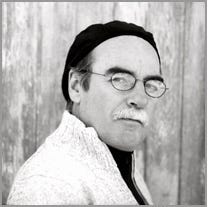
For our first symposium, at 4:30 pm Paris time on Sunday, February 15, we’ll be joined by Terry Glavin. The topic, inspired by Terry’s response to this episode of Critical Conditions, will be, “Has the liberal international order collapsed for good?” (And does Canada’s Mark Carney suggest a way forward?)
Terry Glavin is a journalist, author of seven books and co-author of three more, who has reported in recent years from Afghanistan, Israel, the Russian Far East, the Eastern Himalayas, Iraq, Syria, Turkey, Jordan, Geneva, China, Hong Kong, Taiwan, and Central America. He writes for The Ottawa Citizen, the National Post and MacLeans, and he’s a Senior Fellow at the Raoul Wallenberg Center for Human Rights. He’s won countless literary awards, and he also writes The Real Story on Substack.
(The Zoom link, if you’d like to join, is below the paywall.)
READING ASSIGNMENT
Here’s the reading assignment. (Don’t be dismayed by what looks like more reading than it is: You’ve read some of it already—or you should have, since I sent one of the articles to you twice and mentioned it about a million times, and I’ve cross-posted some of the others. And you’ve probably already watched or read Carney’s speech.)
Required
ARTICLES:

Justin Trudeau went all in on China a decade ago—and nothing can shake his resolve, by Terry Glavin.
Dominic Barton and McKinsey have been China’s best friends in Canada, by Terry Glavin.
“I’ve spent 50 years navigating Canada-China relations. Here’s what I’ve learned,” by Charles Burton. For China, the message to Canadians is clear: America is the past and China is the future, so we must get on the right track,
“A former Chinese inmate on the risks of ‘middle powers’ turning to Beijing,” by Andy Browne.
“What is the Liberal International Order?” by Hans Kundnani. (ou may need to create a JSTOR account to read this. Do this—it’s free—because you’ll need it again and again. Please read carefully; it will spare us wasted time defining our terms.
“The End of Liberal International Order?” by G. John Ikenberry. This was written in 2018, but it sets out the terms of the debate well.
“The Myth of the Liberal Order: From Historical Accident to Conventional Wisdom,” by Graham Allison.
“America vs. the World,” by Robert Kagan. “President Trump wants to return to the 19th century’s international order. He will leave America less prosperous—and the whole world less secure.”
🎧 Robert Kagan discusses this article. (Optional.)
The Age of American Unilateralism: How a Rogue Superpower Will Remake the Global Order, by Michael Beckley
SPEECHES:
Address by Secretary of State Cordell Hull on The War and Human Freedom
Davos 2026: Special address by Mark Carney, Prime Minister of Canada
DEBATE:
“China is a predator and détente should be out of the question,” by Terry Glavin
“There’s no reason to concede that Trump has killed the world order,” by Dan Perry.
“Has the world turned upside down or not?” By Terry Glavin.
“The End of Empires: Will China replace the United States as the global hegemon?” By Claire Berlinski. (You’ve read this already, I hope, but have a look at the exchange between Terry and me in the first footnote.)
“A Reply To Terry Glavin: China, America and Globalization,” by Éamann Mac Donnchada. (Only a few paragraphs.)
Optional but recommended
ARTICLES:
(These are short, and you’ll get a lot out of them, so if you’ve got the time, do give them a go.)
A World Imagined: Nostalgia and Liberal Order, by Patrick Porter.
“China and the International “Liberal” (Western) Order, by Lanxin Xiang” (an interesting article from which I learned things I hadn’t known—but it can and should be vigorously challenged).
“The Day after Trump: American Strategy for a New International Order,” by Rebecca Friedman Lissner and Mira Rapp-Hooper.
After Liberal Hegemony: The Advent of a Multiplex World Order, by Amitav Acharya
“Trump Is Demolishing the Global Order. Here’s What Might Come Next,” a Politico symposium.
“The Liberal Order Is More Than a Myth. But It Must Adapt to the New Balance of Power,” by Rebecca Lissner and Mira Rapp-Hooper
“The Liberal International Economic Order: Toward a New Architecture,” by Patrick Chovanec. This may tell you nothing you didn’t know already. But if you’d have trouble telling me what the terms Smoot-Hawley, Bretton Woods, GATT, WTO, or the Doha Round mean off the top of your head—or if you’re unsure about the significance of the shift of the US from surplus to deficit, creditor to debtor—it’s a good capsule summary. If you’re already strong on 20th century economic history, skip this; but if any of those terms failed to ring a bell, read it.
Chapter 1: “The current rules-based international system and its benefits,” from Present at the Re-Creation: A Global Strategy for Revitalizing, Adapting, and Defending a Rules-Based International System,” by Ash Jain, Matthew Kroenig, Madeleine Albright, and Stephen J. Hadley.
“The Liberal International Economic Order on the Brink,” by Kristen Hopewell.
“Liberalism Doomed the Liberal International Order,” by Stacie E. Goddard, Ronald R. Krebs, Christian Kreuder-Sonnen, and Berthold Rittberger.
“Liberal Internationalism 3.0: America and the Dilemmas of Liberal World Order,” by G. John Ikenberry.
“Beware Mark Carney’s Affection for Authoritarian China,” by Terry Glavin.
“China Couldn’t be More pleased to have Carney as Prime Minister,” by Terry Glavin.
“The Empire strikes back: Greenland and the death of the rules-based order,” by Claire Jones.
“Trump’s Trade Policy is Teaching Partners Washington can’t be Trusted,” by Clark Packard.
“The World-Minus-One Moment,” by Amitav Acharya. Managing the global order with an antagonistic Washington.
“Who Killed the Liberal International Order?” By Nick Danforth.
“An ‘America First’ World.” What Trump’s Return Might Mean for Global Order, by Hal Brands.
“Trump’s Antiliberal Order. How America First Undercuts America’s Advantage,” by Alexander Cooley and Daniel Nexon.
Confronting the Growing Threat from the Chinese Communist Party, from the Macdonald-Laurier Institute.
BOOKS:
Partners of First Resort: America, Europe, and the Future of the West, by David McKean and Bart M.J. Szewczyk. The first chapter, “Establishment and Expansion of the Liberal Order, (1941–2008)” is available for free here and if, after doing the required reading, you’re still feeling uncertain about the history of the liberal order and how it came into being, this will help.
Governing the World: The History of an Idea, 1815 to the Present, by Mark Mazower
Present at the Creation: My Years in the State Department, by Dean Acheson. This is the canonical account of the creation of the postwar liberal order; you can’t consider yourself educated if you’ve never read it. There are lots of free copies on the Internet. If you’ve never read it, at least read a few pages to get a sense of the difference between the men who built the modern world and the men who are thoughtlessly destroying it.
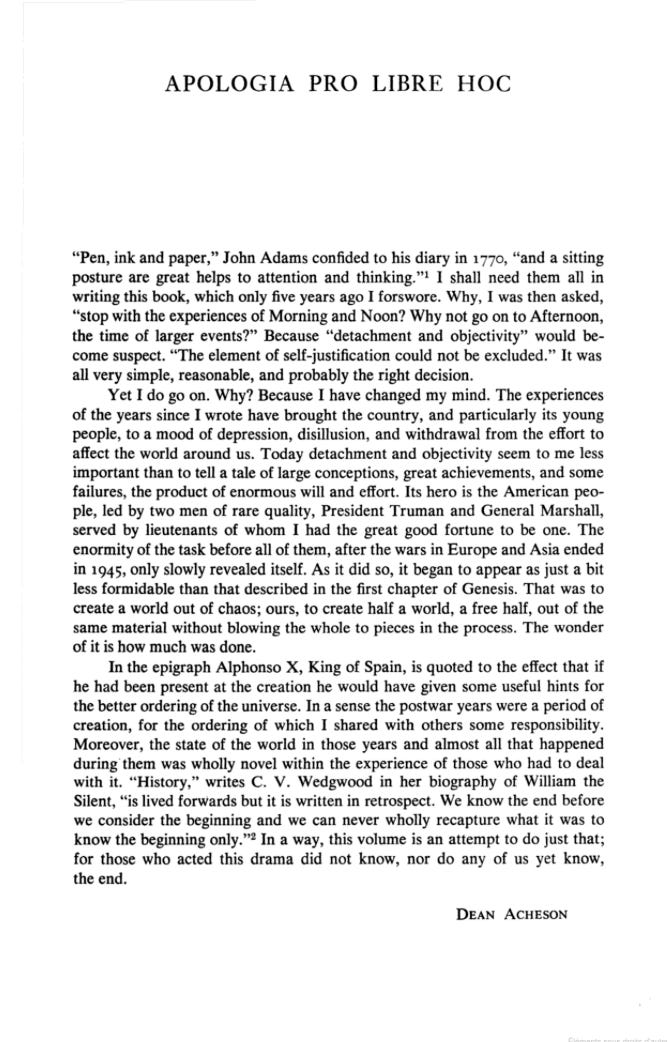
Here’s Acheson introducing the Atlantic Pact, or NATO:
A World Safe for Democracy: Liberal Internationalism and the Crises of Global Order, by G. John Ikenberry. This is probably the best single book to read if you’re looking for a history of the rise and evolution of modern liberal internationalism. From the blurb:
A sweeping account of the rise and evolution of liberal internationalism in the modern era For two hundred years, the grand project of liberal internationalism has been to build a world order that is open, loosely rules-based, and oriented toward progressive ideas. Today this project is in crisis, threatened from the outside by illiberal challengers and from the inside by nationalist-populist movements. This timely book offers the first full account of liberal internationalism’s long journey from its nineteenth-century roots to today’s fractured political moment. Creating an international “space” for liberal democracy, preserving rights and protections within and between countries, and balancing conflicting values such as liberty and equality, openness and social solidarity, and sovereignty and interdependence—these are the guiding aims that have propelled liberal internationalism through the upheavals of the past two centuries. G. John Ikenberry argues that in a twenty-first century marked by rising economic and security interdependence, liberal internationalism—reformed and reimagined—remains the most viable project to protect liberal democracy.
Here’s a good review if you want the short version. (Read at least one review, please.)
Here’s a discussion with the author. (I’m including these videos because I know our class likes having the option, but don’t substitute them for the reading.)
Here’s another one:
Here’s another:
And another:
VIDEOS:
STUDY QUESTIONS
1. What is an international order?
2. Several authors on the reading list argue that the “liberal international order” never existed, or that it’s too poorly defined to be meaningful, or that it’s been hopelessly mythologized. What minimal features have to be present for the concept of a liberal order to be analytically useful, as opposed to a vapid talking point? Have these been in evidence?
2. Kundnani separates the liberal, international, and order components of the system. Historically, which of these has been most important? Which has been the most overstated?
3. Allison says the liberal order is a historical accident, not a coherent design. Sound true to you? Why? What’s the contrary case?
4. To what extent was the post-1945 order actually rules-based, rather than hierarchical but predictable, and does the distinction matter?
5. In 2018, Ikenberry argued that the liberal order faced crisis but not collapse.
Have the assumptions underlying that argument been falsified since then?
6. Which adaptations would preserve the order’s core? Which risk hollowing it out beyond recognition (or utility?)
7. Is “collapse” a useful and accurate term here, or does it involve unwarranted drama and finality?
8. What empirical conditions would have to be met for us to say, with confidence, that the liberal order is no longer operative?
9. Kristen Hopewell writes that Trump represents an intensification of long-standing US trade behavior, not a rupture. Is this so? If it is, what does this imply about American exceptionalism within the order?
10. Kagan claims that Trump want to return to the 19th-century international order. If he’s right, should we understand this as an ideological regression, a strategic improvisation, or just plain indifference to order?
11. Beckley describes the United States as a “rogue superpower.” Can a hegemon remain useful—or even indispensable—to an order it undermines?
12. Xiang argues that China has engaged the liberal order pragmatically rather than ideologically. Is this true? Does selective participation make China a revisionist power or just a rational one?
13. Glavin emphasizes China’s intent, ideology, and repression in assessing China’s role in the global system. When moral imperatives collide with realism and restraint, which is more dangerous: erring on the side of the former, or the latter?
14. Glavin rejects the language of inevitability in accounts of China’s rise and Western decline. Is this right? Do these trends represent irreversible structural changes? Or is this entirely up to us? How would we distinguish them?
15. Under what conditions does détente with an authoritarian power become indistinguishable from acquiescence? Under what conditions does a conflict with a nuclear and economic superpower become pointless, self-destructive, or suicidal? How can we discern the difference?
16. Chovanec focuses on the economic architecture underlying the liberal order. Which economic institutions were most central to the order’s legitimacy, and which ones, if any, undermined it?
17. How significant was America’s role as creditor rather than debtor to the healthy functioning of the order?
18. Carney’s Davos speech described technocratic stewardship amid institutional decay. Is this a plausible strategy for preserving order, or is it evidence of elite insulation from reality (or morality)?
19. If the US proves permanently hostile to the order it built, can Canada and other middle powers meaningfully compensate, or is this just a fantasy? If it is, what else can Canada do?
22. Porter warns against nostalgia for the liberal order, arguing that it distorts our strategic judgment. What policy errors follow from overestimating how liberal, coherent, or universal the order was, and what errors follow from underestimating what has been lost? (Porter is on the optional list, so don’t worry if you don’t get to this one.)
Would you like to suggest a speaker or a topic for future meetings? Drop me a note.
We’ll discuss the writing assignment, for those who are keen, when we convene.
See you on Sunday!
ZOOM LINK
Bookmark this—it’s the same link every week. Here’s an international time zone calculator.
We meet at 4:30 pm PARIS time—every Sunday. (Central European Time.)
