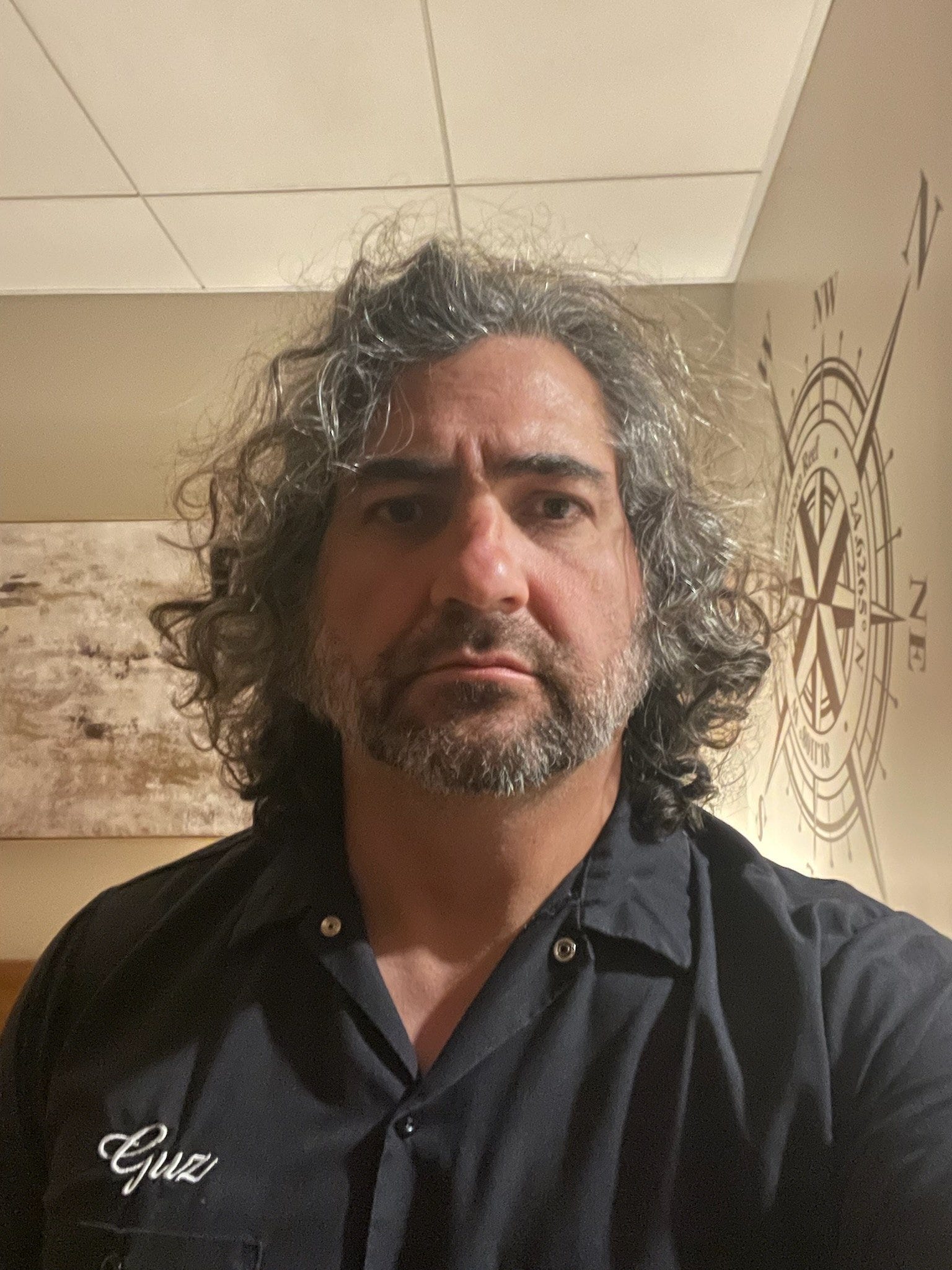
I sent out the invitation to today’s symposium as a cross-post, but it occurred to me that some readers may have disabled notifications for those, so I’m reposting the whole thing. Simon Pearce has kindly organized today’s symposium on the Iran War and the escalation trap. Today’s guests of honor are Adam Karaoguz and Fatima Abo Alasrar.
I joined the military a few months after graduating high school, starting out as undesignated deck seaman and rescue swimmer on the USS Tarawa (LHA-1). Undesignated seaman is probably the closest to the bottom of the food chain as you can get on a Navy vessel. I loved the job- wrote a poem about it, even.
After a few years, I left the Tarawa in San Diego Bay and crossed the Coronado Bridge to attend Basic Underwater Demolition/SEAL training. My class was profiled in the book “The Warrior Elite: The Forging of SEAL Class 228” by retired SEAL Captain Dick Couch. Following that, I spent the next six years as an enlisted SEAL Operator, serving as a Communicator, Joint Terminal Attack Controller, Sniper, and Team Leader. After deployments to South America, Iraq, and Afghanistan, I applied for and was selected to the Seaman to Admiral commissioning program, attending George Washington University in the Elliot school of International Affairs.
As a Naval Special Warfare Officer, I led maneuver elements at the squad, platoon, and troop level in Iraq, Afghanistan, and Somalia, and helped stand up an enduring training element for Ukrainian Maritime Special Forces. Along the way, I finished a Masters in Irregular Warfare from the Naval Postgraduate School. My final operational tour was as a Troop Commander at Naval Special Warfare Development Group, completing the last of ten overseas deployments and over twenty seven years of naval service.
Fatima Abo Alasrar writes The Ideology Machine on Substack. I’ve recently shared her work here—it’s superb. From her bio:
Fatima Abo Alasrar is a non-resident fellow at the Arab Gulf States Insititute. She is the founder of the Ideology Machine, a publication on authoritarian information systems. She is a scholar specializing in Yemen’s conflict dynamics, the Houthi movement, Iranian-aligned networks, and Gulf security.
Her work examines the intersection of ideology, conflict, and great-power competition, with particular attention to how Iranian-aligned movements interact with broader geopolitical currents across the Middle East. Previously, Alasrar was a senior analyst at the Arabia Foundation in Washington, DC, the MENA director for Cure Violence, and a research associate at the Arab Gulf States Institute in Washington. She has been a Mason Fellow at Harvard Kennedy School and an International Policy Fellow at the Open Society Foundations.
From 2006 to 2012, Alasrar worked as an advisor for the Embassy of Yemen in Washington, DC. Earlier in her career, she worked at the British Embassy and served as a program officer for the United Kingdom’s Department for International Development in Yemen.
Alasrar holds an MA in public administration from Harvard University, an MA in international relations from the Johns Hopkins University, and a BS in architectural engineering from Sana’a University in Yemen.
This is a particularly good moment for her to join us, seeing as Yemen just entered the war.
Below is Simon’s summary of the question we’ll be exploring, originally published on his site, The Liminal Lens.(You’ve seen this before—I sent it out a few days ago. This is just for the people who might have missed it the first time.)
The Zoom link, as usual, is at the end of this newsletter, after the paywall.
Introduction: We Are in an Escalation Trap
By Simon Pearce
In a recent discussion with Konstantin Kisin, Prof Robert Pape outlines the key aspects of the escalation trap. It is worth noting that Pape worked on the Joint Comprehensive Plan of Action (JCPOA) on nuclear non-proliferation between the West and Iran in 2015, so he brings certain assumptions to the discussion, and not everyone agrees with all of them.
Either way, Pape is widely regarded as an expert on escalation traps, and I believe the JCPOA was a genuine attempt to avoid such a scenario. He is also an authority on why the US lost the Vietnam War, particularly regarding the limitations of airpower in achieving strategic goals.
Here’s a brief outline of what an escalation trap is:
An escalation trap is a situation in which actors continue increasing the level of conflict beyond the point of rational benefit, because each move makes it harder to step back without incurring unacceptable loss.
It has a recognizable structure:
Tactical success is often mistaken for strategic progress: hitting targets is not the same as achieving strategic outcomes, yet it can still convince you that you are moving forward, even when you are not.
Each side sees its own moves as necessary and the other’s as aggressive, justifying ongoing action–reaction loops
Earlier decisions constrain later choices, creating path dependence
Backing down begins to look like defeat, not prudence
Adversaries start to believe that increasing harm to the other side to force capitulation is the only way to achieve their goals. Options collapse toward a binary: escalate or lose
By the time this dynamic is visible, actors are usually already stuck inside it.
How Did We Get into This Spiral in the First Place?
As I wrote in my initial explanation of how we got to this point, there were some key factors that made this escalation trap very likely to show up at some point.
Here are the key points that explain how the trap was “sprung”.
1. Khomeinist Iran was always a problem that needed managing
The problem of Khomeinist Iran had been managed by the West and its Middle Eastern allies continuously since the Iranian revolution of 1979; in the 21st century, this management system had become increasingly unstable, partly due to the ongoing nature of the regime, partly due to Iran’s pursuit of nuclear weapons.
Why is Iran not a normal country but something that “needs to be managed” in the first place? Claire Berlinski’s essay lays out the big picture explaining why Iran is such a big problem for the world in clear, stark terms. Many Westerners fail to understand the nature of the Iranian regime since the 1979 revolution.
Claire’s essay below is very helpful for understanding the regime in Tehran today.
2. The Obama administration previously attempted to re-stabilize Iranian containment efforts.
Under Barack Obama, the 2015 JCPOA agreement was an attempt to re-stabilize the situation by delaying Iran from acquiring nuclear weapons in return for the unfreezing of long-frozen Iranian cash, and a removal of longstanding sanctions on the Iranian economy.
The agreement:
Allowed Iran limited access to nuclear technology, including a limited number of uranium enrichment centrifuges.
Created a short-notice inspection regime under IAEA supervision to prevent Iran easily breaking out to a nuclear weapon.
Ensured that Iran would require at least 12 months to “break out” and develop nuclear weapons, giving the world time to respond in the event that this happened. JCPOA drafters considered this a healthy margin for error. Iran could not quickly create nuclear weapons without the world noticing, giving us time to act if needed.
3. Trump unilaterally decided to exit the JCPOA agreement in 2018
The first Trump administration repudiated the JCPOA unilaterally, effectively ending the agreement. Trump’s supporters argued that leaving the JCPOA was rational for three primary reasons:
JCPOA would not prevent Iran from getting a nuclear weapon, it would just delay it a bit. Interestingly, JCPOA drafters did not disagree with this. They thought that JCPOA could be used as a mechanism to freeze Iranian nuclear weapons development indefinitely. Trump did not agree.
Trump claimed that it was too easy for the Iranians to cheat due to a lax inspection regime. This claim has been strongly disputed by JCPOA supporters and by the IAEA. After JCPOA effectively ended, the IAEA reported that Iran was keeping to its side of the bargain and only started to violate the deal once the US started to reimpose sanctions on Iran.
Trump claimed that the agreement was too soft on Iran as it both allowed and provided funding for proxy wars and ongoing ballistic missile development. JCPOA placed no limits on “other malign behavior,” including ballistic missile development and proxy wars, and that sanctions relief enabled increased resources for those aims.
4. Some subsequently argued that the US abandoning the JCPOA was catastrophic
The original JCPOA drafters in Europe and America argued that Trump’s decision to leave JCPOA was catastrophic because it was the first stage in springing the escalation trap that we now find ourselves in.
Those who opposed the leaving the JCPOA argued the following:
Tearing up the agreement immediately returned Iran to the path of nuclear weapons development. It brought the date of an Iranian nuclear bomb forward. Specifically, the “breakout time” estimate that was 12 months in 2015 fell to one month in 2021.
From this point onwards, the threat of coercion, sanctions, or actual coercive force, would be the only tool that the West had for preventing Iran from getting a nuclear weapon. This is a classic on-ramp to an escalation trap.
Experts on escalation traps warned, both then and now, that a resort to coercive behavior by the United States would not achieve Washington’s desired goals. They argued that steadily increasing coercive threats would only inspire greater resistance from Iran. Events since the US withdrawal from the JCPOA appear to bear this out. Years of low-grade escalation and counter-escalation have produced the situation we face today: a major war between the United States and Iran.
5. The two biggest powers in the region (other than Iran) appeared to agree with Trump.
The leaders of Saudi Arabia and Israel welcomed the US decision to end the JCPOA. This is noteworthy, as these countries lie directly within Tehran’s firing line in a way that the United States and Europe do not. Their reaction reflects the fact that Iran’s two principal regional rivals had long viewed the agreement as insufficient to guarantee their long-term security.
It is also possible (speculative on my part), that they understood that persuading the United States to withdraw from the JCPOA would, sooner or later, make a U.S.–Iran war almost inevitable—and that this conflict would compel Washington to shoulder most of the costs of confronting their long-standing adversary once and for all. Such logic would be just as compelling in Riyadh as it is in Tel Aviv, albeit risky. Revolutionary Shia Islam poses as much of a challenge to Sunni regimes as it does to the Jewish state. The Iranian Revolution aspires to supersede Sunni, Jewish, Christian, and secular authority alike.
No matter the impact of the end of JCPOA, what’s done is done, and now the world has to deal with the hand that it has been dealt.
How Far Up the Escalation Ladder Have We Already Moved Since the Effective End of the JCPOA?
Quite far.
Since the effective collapse of the JCPOA framework, the region has not drifted toward war, it has moved through a sequence of reinforcing escalations, each narrowing the space for de-escalation.
What we are witnessing is not a sudden rupture, but the unfolding of a system that has been losing its ability to contain conflict through diplomacy, deterrence, and ambiguity. Once those mechanisms weaken, escalation does not appear as a single decision. It emerges as a chain.
Phase I — Breakdown of Containment
October 7, 2023 → ~January 2024
The breakdown began through Iran’s proxy network, specifically Hamas in the Gaza Strip. What had previously been a contained, if unstable, equilibrium gave way to open rupture.
October 7 Attacks (Hamas → Israel)
A coordinated mass-casualty incursion that shattered deterrence and removed any viable political space for limited retaliation.
Israeli Campaign in Gaza
Not simply punitive, but a strategic shift toward the elimination of Hamas as both a military force and governing authority, with significant humanitarian, regional, and political spillover.
Phase II — Expansion Across the Proxy Network
~October/November 2023 → ~April 2024
With Gaza fully engaged, the conflict expanded laterally across Iran’s proxy architecture.
Persistent cross-border exchanges that normalized a two-front conflict, eroding the distinction between contained and regional war.
Israeli Covert Operations Against Hezbollah
Including communications disruption and targeted intelligence-driven strikes, degrading Hezbollah’s operational coherence while remaining below full-scale war.
Houthi Attacks on Red Sea Shipping (Bab el-Mandeb)
The Houthi movement opened a maritime front, targeting commercial shipping through the Bab el-Mandeb Strait. This forced external actors—including the United States and its partners—into active response to protect global trade routes, further internationalizing the conflict and tightening the escalation loop.
Phase III — Direct State-on-State Engagement
~April 2024 → ~June 2024
At this stage, the long-standing buffer of proxies began to collapse, and the conflict transitioned into overt state-on-state warfare.
The 12-Day Israel–Iran War
What had previously been a shadow conflict escalated into a sustained cycle of direct strikes and counter-strikes between Israel and Iran over a short period. This broke a decades‑old constraint: both sides had long avoided prolonged direct engagement, preferring instead to act through proxies or plausibly deniable operations.
Sustained Direct Strike Exchange
Rather than a single retaliatory event, the conflict took on a multi-day, iterative character, with each side calibrating responses while still remaining inside an escalatory loop.
Israeli Expansion of Regional Targeting
A shift from discrete, deniable strikes to systemic targeting of Iranian-linked assets, infrastructure, and personnel across multiple theaters, signaling that the conflict was no longer geographically bounded or strategically contained. This included the targeting of scientists and technical personnel associated with Iran’s strategic programs, reflecting a move beyond degrading capabilities to disrupting the human capital required to regenerate them.
Phase IV — U.S. Entry into Kinetic Operations
~June 2024 → ~late 2024 / early 2025
The conflict crosses a decisive threshold as the United States moves beyond deterrence and into direct, capability-denial strikes on the Iranian homeland.
U.S. Strike on Iranian Nuclear Facilities (e.g., Operation Midnight Hammer)
This was not symbolic participation. The U.S. conducted precision strikes on hardened nuclear infrastructure, using deep-penetration munitions in a sequenced “double-tap” configuration—a capability effectively unique to the U.S. arsenal.
The objective was clear: not signaling, but physical degradation of Iran’s nuclear program at facilities that Israel alone could not reliably destroy. According to Prof Robert Pape, this was a tactical success, but a strategic failure, as it led to the covert dispersal of enriched uranium within Iran, setting the stage for the next phase of escalation.
Phase V — The Current War
~early 2025 → present
At this point, the conflict transitioned from strategic degradation to existential targeting of the regime itself.
Joint US–Israeli Decapitation Strike on Iranian Leadership
The killing of senior Iranian leadership, including AyatollahAli Khamenei, in coordinated airstrikes represents a decisive break from prior norms.
Systematic Targeting of Clerical and Command Structures
Follow-on strikes against senior military and religious figures signal a shift toward regime-level disruption, not merely military defeat.
Why This Became a Cascade
This sequence is more than just a simple “tit-for-tat.”
It is an escalation cascade: a structural dynamic in which:
Each move removes a previously respected constraint
Each response is shaped by the need to maintain credibility after the last move
Each actor becomes more tightly bound to its prior commitments
The perceived cost of backing down rises faster than the cost of continuing
At that point, escalation is no longer driven primarily by intent. It is driven by path dependence. Conflict shifts from being a series of choices to a trajectory.
Once enough constraints have been stripped away—proxy distance, plausible deniability, geographic containment, leadership immunity—the system crosses a threshold where:
The war was not triggered. It was revealed, step by step, as each layer of containment failed and each actor became trapped inside the logic of its previous move.
Degrading leadership and military infrastructure. The US can continue to inflict damage on Iran through long‑range fires—guided munitions launched from land, sea, and air. It can keep targeting Iranian leaders and degrading Iran’s military capabilities, especially missile launchers and related infrastructure. But none of this ensures Iranian capitulation; if anything, it may harden their resolve to keep fighting. The Islamic Revolutionary Guard Corps (IRGC) and the paramilitary Basij together field at least 500,000 personnel, and likely many more. These forces form the regime’s ideological core and are highly committed to its survival.
US precision weapons are also enormously expensive and will need to be replenished. Congress holds the purse strings and is reluctant to provide the funds, as it was not consulted prior to the launch of “Epic Fury.” Many lawmakers viewed this as a usurpation of their constitutional authority to declare war.
Destroying civilian and economic infrastructure. Israel, though not the United States, has already begun this process by striking the South Pars gas field and fuel storage facilities around Tehran. Iran duly retaliated by taking offline a substantial share of oil, gas, and refining capacity—likely for years to come—in Qatar, Saudi Arabia, Israel, Kuwait, and elsewhere in the region. For now, this exchange appears to have paused the escalation in economic warfare, but it could easily resume at any moment.
What Iran is doing now:
Making the Strait of Hormuz too dangerous for civilian or military ships to transit, except those carrying Iranian oil and other goods. By effectively threatening to close the Strait of Hormuz with sea mines, drone strikes, fast attack boats, and missiles, Iran can hold the global economy to ransom. Reports indicate that Iran has already begun charging selected civilian ships US$2 million each—payable in Chinese yuan—to transit the strait. They have made this threat credible by striking many civilian ships already.
This is a dangerous game for Iran to play: as the economic costs increase, the US will find this status quo intolerable, and be forced to decide between backing down, or even more escalation.
Hoarding and replenishing their reserves of missiles and drones. As long as Iran has a credible threat of being able to destroy civilian and economic infrastructure in the Gulf and in Israel, including attacks on shipping, they can cause economic harm to the world. This gives them a bargaining chip in negotiations. As long as they hold these weapons, they can use them to deter further US escalation while maximizing their current revenues, and their leverage for the future.
Doing maximum damage to the Gulf (GCC) economy at the lowest possible cost to themselves. The longer and deeper the global economic disruptions from the war, the stronger Iran’s relative position becomes. Iran’s oil (that it mostly sells to China) is going up in price while its Gulf rivals are starved of cash by the blockade of Hormuz. Tankers carrying Iranian oil to Asia leave daily, unmolested. Meanwhile tankers from the UAE, Saudi Arabia, Iraq, and Kuwait are mostly unable to move. Meanwhile, the Iranians are using occasional missile and drone strikes to severely damage the Gulf (GCC) economy.
The challenges the US now faces
Making the Strait of Hormuz safe for civilian shipping. About 20 percent of global crude oil usually transits the Strait of Hormuz, but Iranian attacks on civilian shipping have largely halted this traffic. The U.S. cannot currently ensure safe passage, driving U.S. gasoline prices from about US$3 to US$5 per gallon and likely causing worse impacts abroad. Continued disruption threatens not only gasoline supplies but also diesel, fertilizer, and LNG, increasing the risk of a major global economic recession.
Fully protecting regional economic and life-sustaining infrastructure, airports, and US bases. Iran possesses an unknown stockpile of ballistic missiles and drones, which have already caused significant long-term economic damage to the GCC states. Over time, expensive defensive interceptors could be depleted, allowing relatively cheap Iranian drones to swarm and inflict substantial additional harm on critical infrastructure and economic assets. Because the GCC imports most of its food and relies heavily on desalinated water, there is a real potential for a major humanitarian crisis to emerge.
The challenges Iran now faces
Iran’s position is stronger than it appears in the short term—but it is structurally fragile in ways that become more pronounced the longer the conflict continues.
Sustaining the closure of the Strait of Hormuz. Iran’s leverage depends heavily on its ability to keep the Strait of Hormuz functionally closed. This is not a one-time action—it requires sustained exposure to US and allied strikes on coastal missile batteries, drone launch sites, naval assets, and logistics nodes. The longer Iran maintains pressure on shipping, the more it invites systematic degradation of the very capabilities that give it leverage in the first place.
Preserving its own economic lifelines. Iran is attempting to weaponize global energy flows, but it remains dependent on its own oil exports—primarily to Asia. Any sustained disruption to export infrastructure, especially hubs like Kharg Island, would have a disproportionate impact on its economy. This creates a tension: the more aggressively Iran pressures the system, the greater the risk of losing its own revenue base.
Absorbing sustained military degradation. US and Israeli strikes are not just symbolic—they are steadily degrading missile systems, infrastructure, and leadership networks. Gulf states are already pressing for Iran’s long-term strike capabilities to be permanently reduced. Iran can absorb punishment for some time, but the cumulative effect of precision strikes on a finite military-industrial base will begin to show.
Maintaining internal stability under pressure. Iran enters this conflict with pre-existing internal strain—economic weakness, sanctions pressure, and periodic domestic unrest. Prolonged war increases the risk that internal cohesion begins to fray, particularly if economic conditions deteriorate further or leadership transitions create uncertainty. The regime’s objective is therefore not victory in a conventional sense, but survival under pressure.
The Iranian regime may be closer to collapse than we realize:
Iran’s strategy is coherent in the short term: use geography, asymmetry, and economic disruption to offset conventional weakness. But it is not cost-free. The longer the conflict continues, the more Iran is forced to trade:
current leverage for future capability
economic pressure on others for damage to its own system
sustaining war for risk of internal collapse
That is the bind the remaining leaders of Iran now face.
Where to from here?
Broadly speaking, there are three paths that this conflict might take.
Status quo
Deescalation
Escalation
Let’s look at each in turn.
1. Status Quo
The current status quo is unstable for the United States and for much of the world. The Strait of Hormuz is closed to most shipping, and this is beginning to strangle the global economy. It’s not just gasoline and diesel that are affected, but also fertilizer, LNG, sulphuric acid, and helium. This has already caused a global slowdown in economic activity, as well as shortages and inflation. The longer Hormuz remains closed, the worse these effects will become. For this reason, the United States and its allies find the current status quo intolerable and are strongly committed to finding a solution as soon as possible.
Verdict: the status quo is somewhat manageable for Iran, but utterly intolerable for the US, so the US is highly motivated to find another solution. The longer this goes on, the worse it gets for the world economy. The US cannot afford to be patient here.
2. Deescalation
Deescalation can take many forms, but it is important to recognize that neither side is likely to trust the other’s statements during negotiations, making implementation difficult. Although many issues would need to be addressed to achieve de-escalation, four are especially critical for the main combatants.
From the American perspective:
Hormuz must fully re-open to all traffic, without tolling or interference
Iran must give up its enriched uranium
From the Iranian perspective:
The US must withdraw its military assets from the Gulf to prevent a repeat of what just happened
The US must limit or suspend military support for Israel, at least to the extent that Israel is unable to launch another attack on Iran in the near future
Neither side seems likely to agree to any of this at the moment.
The Iranians are still selling their oil and can charge tolls to others for using the Strait of Hormuz. The longer this continues, the more leverage they gain, so they have no incentive to act quickly. By contrast, the US has every incentive to try to force their hand.
Rather than concluding that their pursuit of a nuclear weapon caused this crisis, the Iranians are likely to decide that a credible nuclear deterrent is the only way to get the Americans and Israelis off their backs for good. They will not give up their enriched uranium.
The US is not going to agree to withdraw from the Middle East. Such a withdrawal would be humiliating, further erode confidence in the dollar, and preserve a de facto Iranian toll road over Hormuz. Once the US leaves, the entire GCC would be held to ransom, indefinitely, by Iran.
Even if the US vacated the Gulf, Israel is not going to allow a weakened Iran to regain full strength only to attack them again later. The Iranians know this, so they would likely demand that the US fully muzzle Israel, including cutting support for US weapons systems already sold to Israel and blocking future arms sales.
Beyond these tactical considerations there is also the point that Claire made in her essay: Iran is ideologically committed to the destruction of Israel, and that has not changed.
Verdict: The Iranians now have a clear incentive to hold out and prolong negotiations. The longer the Strait of Hormuz remains closed, the more pressure the United States will feel to reach a resolution. At the same time, it is hard to see either side accepting any of the four demands listed above. In that scenario, further escalation becomes much more likely.
I assign a 20 percent probability to de-escalation. This would require a straightforward cease-fire by the US and Israel in exchange for Iran reopening the Strait of Hormuz to all traffic without tolls. Over time, the remaining issues, including the status of enriched uranium, would be negotiated.
I see this as unlikely because the two sides hate each other, have zero trust, and may both believe they can prevail through escalation. While the US is militarily superior, the Iranians believe that the US is brittle, fickle, and will withdraw if the fight becomes difficult. In addition, Israel will do everything in its power to prevent the US from agreeing to any deal that does not address Iran’s nuclear material.
3. Escalation
As I have shown, the status quo is untenable for the United States, and de-escalation lacks a clear mechanism. I currently conclude, with approximately 80 percent certainty, that escalation is the most likely next outcome.
The United States is not yet fully postured for escalation; forces are still arriving in theater. This creates a short window in which Washington can test whether a deal is still possible.
Iran, for its part, slow-rolls the process. Each additional day that the Strait of Hormuz remains disrupted increases Tehran’s relative bargaining leverage.
As US forces build up, Washington uses the visible accumulation of capability to signal seriousness and press for concessions. Tehran responds by probing for maximal terms while publicly insisting that no deal is on the table.
In the background, markets begin to panic. This is not incidental—it is part of Iran’s strategy. Financial stress increases pressure on Western governments, raising the likelihood that the United States will offer concessions to get the strait open again.
Phase 2 — A Fight for Strategic Territory (~2-4 weeks)
With negotiations exhausted, the conflict shifts decisively toward control of key terrain. US attention narrows quickly to two decisive objectives: the Strait of Hormuz and Kharg Island. These are the critical physical nodes through which energy flows, revenue is generated, and strategic leverage is exercised.
The United States needs to:
Make the Strait of Hormuz safe for civilian shipping by any necessary means. This will require high‑intensity land, sea, and air operations across a wide area, including very difficult terrain.
Secure Kharg Island while preserving the energy infrastructure and preventing its destruction by Iranian forces.
For Iran, the objective is twofold:
In the Strait of Hormuz: continue to deny access while imposing maximum cost and uncertainty. Maintain pressure on global markets and Western political systems through the use of mines, missiles, drones, and fast-attack craft—not to win a decisive naval battle, but to keep the Strait persistently unsafe.
On Kharg Island: turn the island into a death trap for US forces, much as New Zealand and British forces did during the German invasion of Crete in World War II. The Germans won the battle, but their entire airborne division was rendered combat-ineffective for the rest of the war and never fully reconstituted.
This phase is likely to be extremely bloody, and the United States has every incentive to act as forcefully and rapidly as possible once it decides to move forward. Political considerations, however, may limit the size of the US ground force buildup in the Gulf to a level below what would be optimal for a land incursion. Because the Iranians will have prepared defensive positions, they will attempt to inflict sustained casualties on US forces in order to fuel an anti-war movement in the United States, thereby securing a political victory, much as the North Vietnamese did during the Tet Offensive.
Phase 3 — Expansion of the War, Regionally (immediate risk, upon commencement of Phase 2)
From Iran’s perspective, once Phase 2 begins, they may quickly conclude that they should escalate their strategy of economic warfare. So far, for the most part, closing the Strait of Hormuz has caused only temporary damage to the global economy. Once the US moves ground troops onto Iranian territory, however, there is a very high chance that the IRGC will decide to inflict more lasting damage through a sustained missile and drone campaign against economic targets across the Gulf region.
At that point, we could see major attacks on LNG plants, oil refineries, fertilizer plants, oil and gas fields, and commercial shipping. Even if most of Iran’s missiles and drones are intercepted, the cost to the US and its allies in interceptors would be enormous.
This is where the situation could become chaotic. Gulf states are very likely to engage in direct combat operations against Iran. The US or US allies might engage in strikes on Iranian economic and power-generation assets. These operations might also cascade into “tit for tat” attacks on desalination plants, potentially triggering a humanitarian crisis across the region.
The one factor that might prevent this is a US/IDF degradation of Iran’s long-range fires to the point that they can no longer achieve their objectives. If that were to happen before the US launches ground incursions, the war could begin to shift toward a US victory—albeit a potentially costly one in terms of US Marines’ and airborne troops’ lives.
Phase 4—Further Escalation Risks
Beyond a regional war, there are additional escalation risks. These mostly fall into two categories:
Limited incursions by US forces could turn into a quagmire, similar to the Gallipoli campaign in World War I, as both sides rush more and more ground troops into contested areas.
Non-regional players such as China and Russia could become involved, especially if the course of the war begins to harm their interests directly, or if they see an opportunity to inflict a strategic defeat on the United States without serious repercussions for themselves.
At the moment, both of these outcomes seem unlikely. However, in a situation as volatile as this, conditions can change very quickly.
We will discuss these scenarios during the upcoming Sunday Symposium, the video of which will be published on The Cosmopolitan Globalist next week.
Thank you Simon!
If you’d like to join, there’s no reading required this week. The Zoom link is below the paywall. All subscribers are warmly invited!