


Very few of you are free to meet Sergei Cristo at the times I suggested, so here’s what we’ll do. I’ll invite Sergei to join us not tomorrow, but on the following Sunday—June 14—at the usual time, via Zoom. Meanwhile, I’ll record a podcast with Sergei while he’s in Paris, which I’ll post in advance of the symposium along with the reading.
As for tomorrow’s symposium—which will be held at our customary hour, 4:30 pm Paris time—we’ll be joined by a guest I could hardly be more delighted to welcome: My Pop. Or as you may know him, David Berlinski: mathematician, essayist, novelist, polemicist, philosopher of science, and ornament of civilization.
If you’re not familiar with my father, this interview will fill in the background:
This isn’t a symposium about why everyone ought to read more. Everyone knows he should read more, just as everyone knows he should floss after meals and stop looking at the Internet in bed. The question isn’t whether reading is good for us. It’s much more interesting: What does it mean to read well?
Even educated adults are never really taught this. They’re taught to decode words, pass examinations, extract themes, underline sentences, take notes, and dutifully produce the kind of lifelessly correct observation that makes English teachers wonder whether accountancy might have been the braver life. Reading well is not the same thing as extracting “the main idea.” Nor is a matter of agreeing or disagreeing with the author. It’s not even the same as finishing the book.
Reading well is a way of noticing: structure, rhythm, implication, irony, proportion, motive, evasion, beauty, vulgarity, force, fraudulence, charm. It involves knowing when to slow down and when to skim; when a sentence is carrying the argument and when it’s just carrying water; when a character is saying what he means and when the author is saying something behind his back; when the prose is merely pretty and when it comes alive.
It’s a dying art. I don’t need to rehearse the reasons for this—or the consequences of it. We’ve discussed them many times. We live in the age of TikTok videos and automated prose. The Internet hasn’t abolished the written word, precisely, but it’s replaced it with a form of language that has little to do with reading: one that’s fast, reactive, tribal, performative, dumb, and artless. Against this, reading—really reading—is almost eccentric. But it’s the last defense of the independent human mind.
Years ago, my father, brother, and I had spoken of writing a book together called How to Read. Not some pious defense of the Great Books or a list of improving assignments. We wanted to write something more practical: a guide to the habits of mind by which good readers actually read. How should you approach a short story? An essay? A novel? A difficult argument? A paragraph that seems simple but isn’t? A book that’s much better than its reputation? A book that’s much worse than its reputation?
Then, as often happens to our excellent ideas, we forgot all about it. Or rather, I vaguely remember it; my father claims not to. But he’s agreed to talk about it all the same.
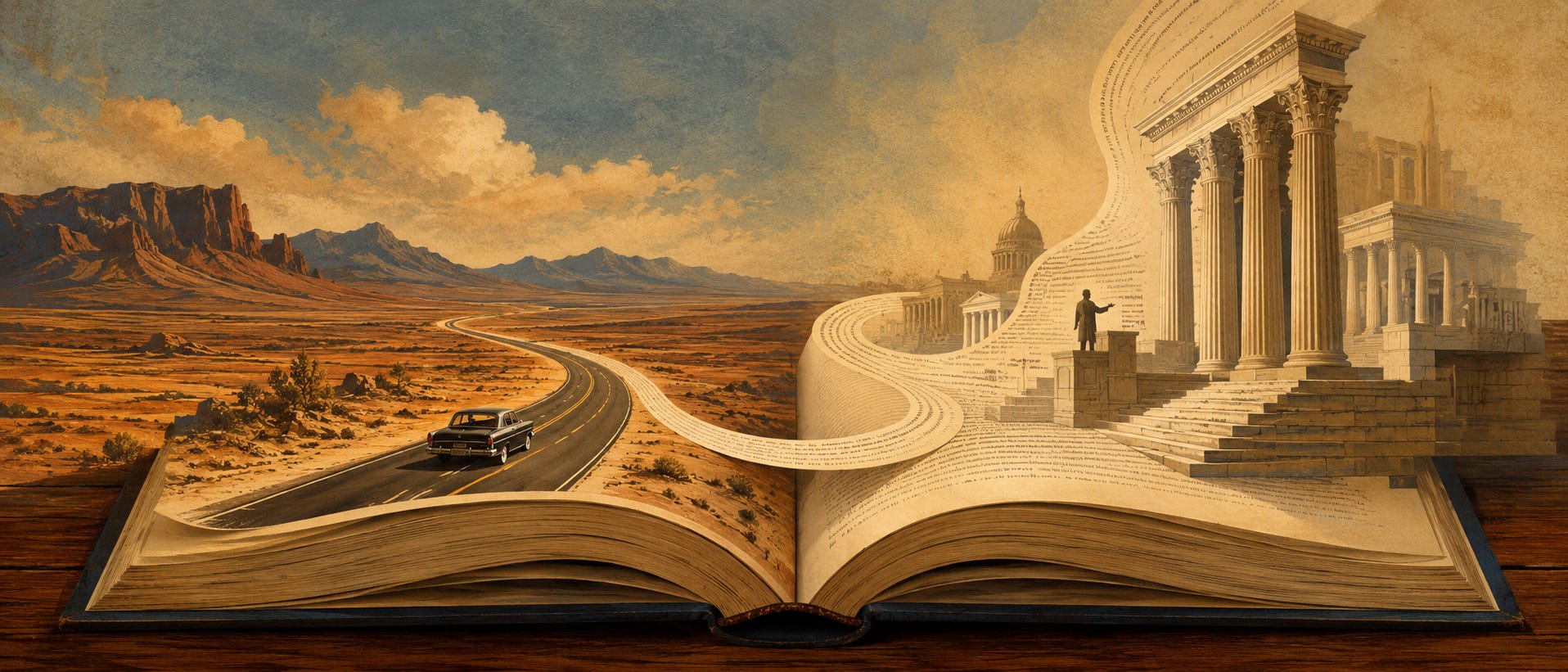
For this week’s reading, I’ve appended, below the paywall, two texts. The first is one of my father’s own short stories. The second is a very different thing—it’s Abraham Lincoln’s Lyceum Address, delivered in 1838 by a very young man in a very young republic.
We’ll use these texts as occasions to ask what a good reader notices. How does a text work? Where is the pressure in the prose? What does it disclose directly, and what does it disclose obliquely? What’s the relation between style and meaning? What does a story know that its characters may not? What does a political speech know that its audience may not wish to know? What does the reader have to supply?
The two texts differ almost completely in genre, occasion, scale, and voice. One is private, retrospective, and fictional; the other is public, prophetic, and political. One looks back across a life; the other looks forward into the dangers facing a republic. One moves through the American West; the other through the American inheritance.
But they are related.
As you read, notice the distances: between youth and age, promise and possession, inheritance and understanding, America imagined and America encountered. Ask yourself what each text knows at the end that could not quite have been known at the beginning.
Feel free, if you like, to bring any sample of prose that interests or vexes you to the discussion. We can discuss any text that causes you to think you’d like to understand it better.
This will be a delightful conversation. We’ll talk about books, words, sentences, intelligence, and the habits of mind that make civilization possible. It will be a nice break from talking about the Strait of Hormuz, war, Donald Trump, and the death of liberal democracy.
As usual, the Zoom link is below the paywall.
See you tomorrow! I’m especially looking forward to this.
