

A Symposium Scheduling Question
Who'd be willing to meet on Monday instead of Sunday for Sergei Cristo? (Just this once.)

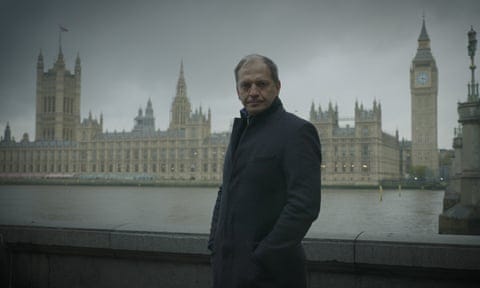
Some of you will remember my friend Sergei Cristo from previous podcasts and discussions. Among other things, he was the star of the podcast Sergei & the Westminster Spy Ring, in which he helped to expose Russia’s interference in British politics.
Here’s a review of that podcast from the Guardian:
The indomitable Carole Cadwalladr of this parish and the equally dogged Peter Jukes of Byline Times have joined forces to make the new podcast Sergei & the Westminster Spy Ring, an investigative series that tells a modern tale of Russian influence in and on the UK. The blurb informs us that “not since the reach of the Cambridge spy ring … has the Kremlin been so successful in penetrating the highest echelons of British intelligence.” Yep, we’re talking spies. But this is no all-action Bond tale; instead, it concerns Russia’s gradual infiltration of the UK’s political hierarchy.
The story is built around Sergei Cristo, a Russian-born British citizen who came to the UK in the 90s and worked as a fundraiser/activist for the Conservative party. About 15 years ago, Cristo met diplomat Sergey Nalobin, whose father had been in the KGB. Nalobin seemed keen to find out if any politicians might be interested in forming a Conservatives for Russia group. Suspicious, Cristo gave him nothing but watched as Nalobin gradually parlayed his way into making Tory friends and influencing people.
By episode two, Cristo is seriously worried but can’t seem to get either the Metropolitan police or MI5 interested. The Conservative Friends of Russia group is launched with a big party and bad jokes about Pussy Riot. But it’s in the third episode, released last Tuesday, that things properly get going. It’s 2012, and political bloggers and strategists, as well as politicians themselves, are busily wooed by Nalobin and friends. Russia wants to know how to use the internet for election campaigning. “They basically opened up all their learnings to Russia,” says one person who was there. This is soft power with hard consequences (episode 4 will cover Brexit), and Sergei & the Westminster Spy Ring, though a little slow at times, does a great job of unpicking sexy Russian obfuscation and Tory and MI5 slackness to reveal what’s actually been in plain sight for years. Recommended.
(I didn’t think it was slow at times. I thought it was riveting the whole way through, and I’d heard the whole story before, too. It’s really well done.)
Following his encounter with Nalobin, Sergei decided that he wanted to understand this phenomenon in depth. He’s now getting a Ph.D. in Security and Intelligence Studies at Buckingham University. His research focuses on the way Western capital supports authoritarian regimes, ultimately undermining the liberal democracies whose openness gave investors the opportunity to acquire so much capital in the first place.
His research has already exposed the way so-called “sustainable” funds poured into Russia in the run-up to the full-scale invasion of Ukraine. A few highlights from the paper he published about this, titled “When Green Turns Red: Security Implications of “Sustainable” Investments in Russia.”
… This research has uncovered enough empirical evidence to highlight at least three serious problems. First, the funds invested in Russia in the run-up to the full-scale invasion of Ukraine ran counter to the spirit and letter of sustainable investing commitments.
Second, several of the top ten European asset managers (the largest, most reputable and trusted fiduciaries of ordinary people’s savings and pensions) effectively misused their sustainable funds to help equip Putin’s war machine in various ways. It is far from a mere rhetorical point. As explained below, most of the European “sustainable” assets come from pension funds and people’s savings, and that their funded Russian investee entities enabled the Kremlin’s ambitions not only indirectly (major revenue earners for the regime and its elites) but in many cases directly (suppliers to military manufacturers, sponsors of military units, parts of state propaganda and disinformation, bankers of covert military operations abroad). Moreover, the way those entities fit within the oppressive regime was well known long before the war began in 2022, as this research illustrates.
And third, that the regulatory investment sustainability framework remains not only largely ineffective and unenforceable, but also largely unresponsive to geopolitical realities. This framework of the European Union (EU) continues to be in force, given that the European Commission effectively postponed SFDR reforms till 2027 despite accepting much criticism that it was not fit for purpose.
These points relate to the societal significance of this research. As mentioned above, much of the money that has supported oppression in Russia and around the world did not come from some evil anonymous source. It came from the savings and investments of ordinary people. It is our money. In these sustainability-conscious times, most Europeans want their investments to be used to improve the life on this planet, and not damage it. Moreover, the question of whether sustainable funds should be allowed to invest in oppressive regimes is particularly important, as the European Commission has de-prioritized its SFDR reforms initially expected in 2025, and is shelving them until at least 2027.
Sergei just launched what’s shaping up to be a great new Substack, too, focused on Russia’s subversion of Western democracies.
Sergei is at the Oslo Freedom Forum right now, and on his way back, he’s stopping in Paris.
I thought this would be a great opportunity to have him join our symposium. I had two ideas in mind for a topic, in particular:
Is your retirement fund kidnapping Ukrainian children?
Why won’t the UK conduct a proper inquiry into Russia’s role in Brexit?
Unfortunately, his flight doesn’t get in until 18:45, Paris time, on Sunday. He suggested doing it on Monday, instead, but I don’t know how many of you would be free on Monday. He wouldn’t be free during the day (in Paris) on Monday, so if we did that, it would be at about 5 pm Paris time, which is close to our usual time.
How many of you would join if we held the symposium on Monday afternoon?
How many would join if we held it later on Sunday evening (in Paris), which for many of you would be Sunday afternoon? I don’t know if Sergei will be up for that—he’ll have just flown in after a demanding weekend, and he may be tired—but if it’s the only time people can make it, I’ll ask him. If more than a dozen of you say you could do one or the other, I’ll invite him. Show of hands?
You can say “yes” to both. You can also suggest a time that suits you better in the comments, assuming the constraints above:
⏰ WORLD CLOCK: TIME ZONE CONVERTER⏰
By the way, if it turns out that we have some flexibility with our scheduling, a few guests whom I’ve wanted to invite are never free on Sundays. They have church or family obligations that make the day impossible for them. If we could occasionally meet on another day, I could, for example, invite the biotech entrepreneur Yuri Deigin—who was one of the first to say that the zoonotic theory of Covid’s origins wasn’t nearly as strong as purported—to talk to us about how far we might be from functional immortality:
(He could also discuss the origin of Covid. Both would be super-interesting.)
Other guests have also said to me that Sundays are categorically bad for them. So even if neither of the times I’ve suggested above work for you, if there’s another day or time that generally would work, let me know in the comments.
If the times above don’t work for anyone this week, I’ll be looking for a guest for Sunday at the last minute. Is there a topic you’d particularly like to discuss? That would help me to narrow it down.
Let me know.
I'm in either day. Great topic!!
I remember listening to that podcast while walking to school pick up and attracting some rather curious looks from passing passers by as I either had my mouth agape for more than a few seconds or I was saying things like, "No way!" "How could that happen?" and "What is wrong with these people?". I passed it along to my Romanian friend who was also immediately hooked. It was not slow!!!
I can usually never attend symposiums due to family things, but as long as you keep hosting them I will keep trying to attend them! Sergei would be an excellent guest, and especially with the Armenian elections coming up (cue more Russian interference) it's still very much relevant even if Putin is allegedly slightly on the back foot.
Thanks for pulling these together!